September 19: International Observe the Moon Night

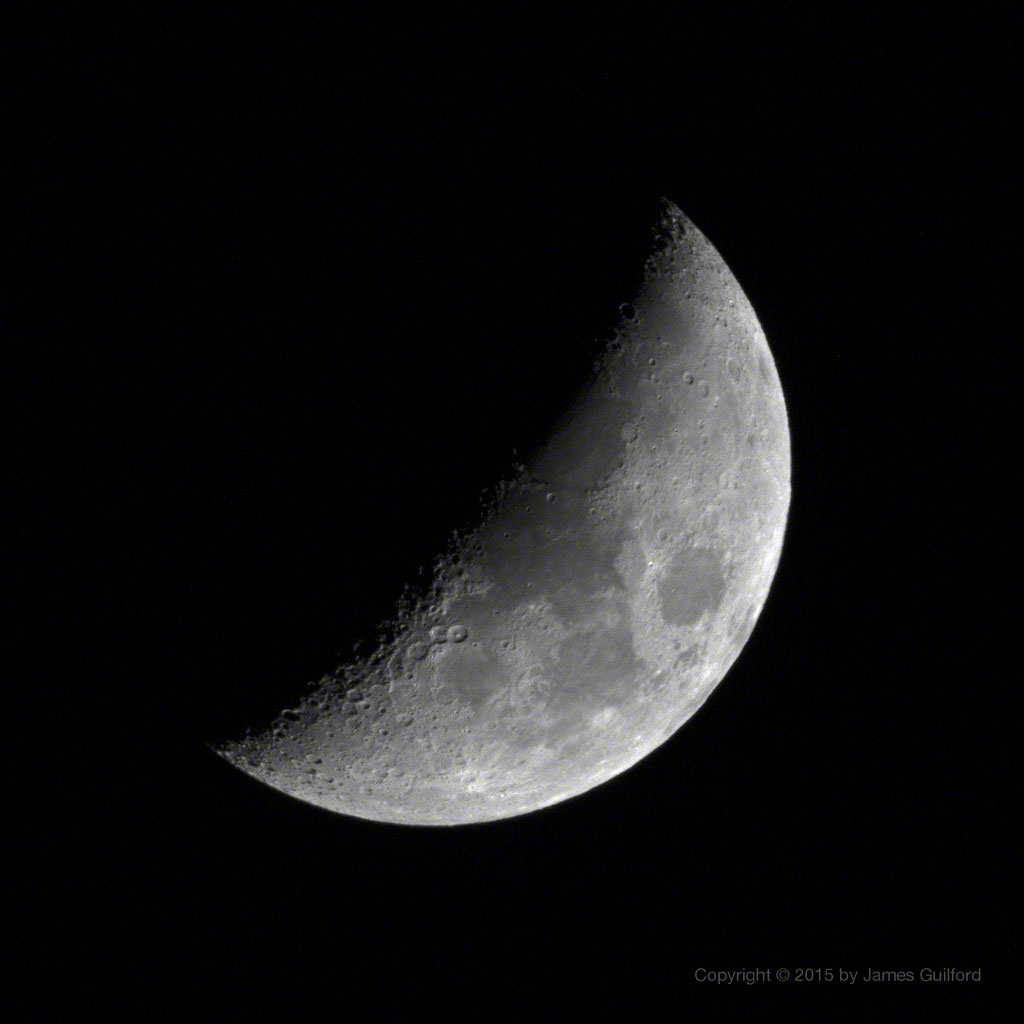
Photo: Waxing Gibbout Moon. Photo by James Guiilford.
The Waxing Gibbous Moon – Night Before First Quarter

UPDATE: It was a confusing night with the sky quickly changing from clear to overcast, overcast to clear, and so on! In all 14 folks took a chance and came out. Trees and clouds blocked our view of the Moon on, of all things, International Observe the Moon Night! Patient visitors did receive views of the Andromeda Galaxy, and the Perseus Double Cluster. The last to leave observed the path of the Milky Way’s star stream overhead and the dark areas created by interstellar dust clouds!

Stephens Memorial Observatory of Hiram College will be open to the public on Saturday, September 19, from 9:00 to 11:00 PM as a local venue of International Observe the Moon Night (InOMN).

The InOMN is an annual, world-wide public engagement program that encourages observation, appreciation, and understanding of Earth’s Moon. Everyone on Earth is invited to join the celebration by attending an InOMN event — and uniting on one day each year to look at and learn about the Moon together. This year’s InOMN takes place just one week ahead of the much-anticipated total lunar eclipse taking place the night of Sunday, September 27.

No reservations are required and there is no admission fee for observatory public nights. Overcast skies or inclement weather at the starting time cancel the event and, in that case, the observatory will not open. For updates and more information, see the observatory’s Web site: StephensObservatory.org or “@StephensObs” on Twitter.

The Observatory is located on Wakefield Road (Rt. 82) less than a quarter of a mile west of Route 700 in Hiram. There is no parking at the Observatory. Visitors may park on permissible side streets near the Post Office, a short distance east of the observatory.

Click here for a handy map showing the Moon as it will appear during InOMN with some interesting features highlighted!
Perseid meteor shower a good show

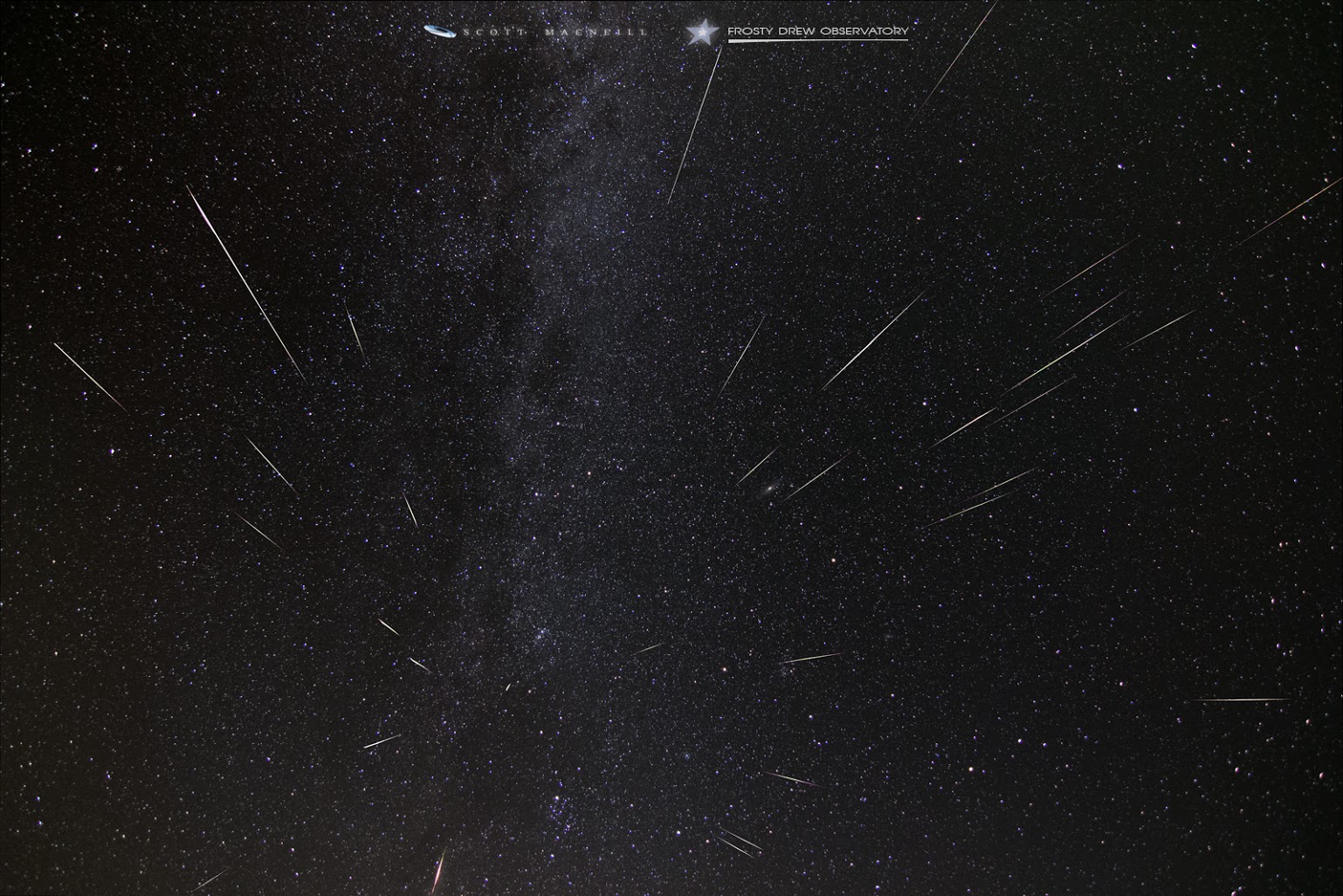
Photo: 2015 Perseids meteor shower imaged over five hours by Scott MacNeill
2015 Perseids Peak by Scott MacNeill, Frosty Drew Observatory, Charlestown, Rhode Island – http://exitpupil.org/

For those with a dark site from which to watch, and the patience to “wait for it…” the 2015 Perseids meteor shower was a good show. Reports from around the world noted substantial numbers of “shooting star” sightings. In the Northeastern Ohio area, amateurs reported from 25 to as many as 57 meteors per hour from good viewing locations. Local observers reported seeing persistent trains, greenish colors, and even flares from some meteors.

The NASA All-Sky “Fireball Network” recorded hundreds of meteors during the event peak, the night of August 12 to 13. “The Perseid shower last night was an almost perfect combinations of circumstances – no Moon, decent shower rates, and clear skies over much of the network,” wrote Dr. Bill Cooke, Meteoroid Environments Office, NASA Marshall Space Flight Center.

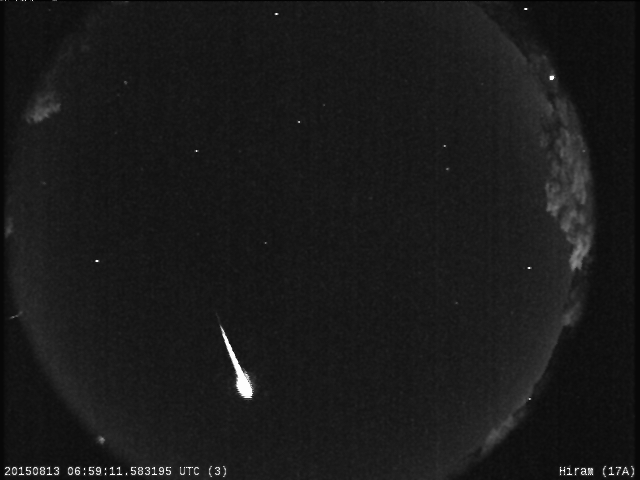
Photo: Long Trail of a Perseid Fireball Recorded at 9:42 PM, August 12 via NASA All-Sky Fireball Network
Long Trail of a Perseid Fireball Recorded at 9:42 PM EDT, August 12

The Fireball Network camera system located on the campus of Hiram College recorded a good number of fireballs — meteors brighter than the planet Venus — overnight including several that appeared directly overhead and at least one that appears to have ended in a flare … a bolide. In the images we have posted here, the top of the photo is north and the bottom is south.

Photo: Apparent Perseid Bolide over Hiram at 2:59 AM EDT. NASA All-Sky Fireball Network
Apparent Perseid Bolide over Hiram at 2:59 AM EDT, August 13

The Perseid meteors are associated with the stream of dusty debris called the Perseid cloud and stretches along the orbit of the comet Swift–Tuttle. Meteors appear when Earth passes through the dust cloud and bits of cometary material plunge into the atmosphere where friction heats and vaporizes them. The debris particles enter Earth’s atmosphere at around 35 miles per second and most are about the size of grains of sand. The name of the shower is derived from the fact that the meteors, if traced back along their paths, appear to radiate from the constellation Perseus.

Saturday, August 22: Open Night

Moon in Daylight Sky
UPDATE: The August 22 Open Night was a tremendous success seeing 49 visitors overall! Early arrivals were not only treated to good to excellent views of Earth’s Moon but fair to good sightings of Saturn and several of its moons as well! Over the course of the night we were able to observe open star clusters M6 (Butterfly), M7 (Ptolemy’s) in Sagittarius, and the Double Cluster in Perseus; globular clusters M28, and M22 in Sagittarius; and the Andromeda Galaxy or M31 as catalogued by Messier. The exploration ended, nearly on time, as clouds moved in from the southwest obliterating our viewing of “faint fuzzies” like globular clusters! Thanks to all who attended!

Stephens Memorial Observatory of Hiram College will be open to the public on Saturday, August 22, from 9:00 to 11:00 PM. On the observing list for the night are: the First Quarter Moon (early), and a couple of star clusters including M4 in Scorpius, finishing with the Andromeda Galaxy (late). Please note that the Moon will become obscured by neighboring trees before the end of open hours; arrive early if you wish to see it!

Clear skies are a necessity for viewing of faint objects like star clusters so visitors should keep up on current weather conditions: cloudy skies at the starting time cancel the event and, in that case, the observatory will not open. Check back here or via the observatory’s Twitter account for late Open Night status! Our Twitter handle is:  @StephensObs

No reservations are required and there is no admission fee for observatory public nights.

The Observatory is located on Wakefield Road (Rt. 82) less than a quarter of a mile west of Route 700 in Hiram. There is no parking at the Observatory. Visitors may park on permissible side streets near the Post Office, a short distance east of the observatory.

Sunny day surprise

Photo: Image showing granular structure of the Sun's photosphere. Photo by James Guilford, Stephens Memorial Observatory.
Granular Sun – July 20, 2015
Testing out a modified eyepiece adapter today, I had the vintage Cooley Telescope pointed at the Sun. Since everything was set up, I decided to see whether we could capture decent images of our nearest star, near noon on this clear summer day. While the sky was clear, the seeing — quality of the view — was not as good as I’d hoped. Apparently, midday heat was causing the image to “shimmer” in the eyepiece and the photographs reflected that. Examining the pictures on the computer screen, I was disappointed because I saw no details in the several sunspots visible. As I made some photographic adjustments, however, other features came into view: granulation and faculae! The granules, upwelling super-hot cells of solar atmosphere, are easy to see; they give the image above a “grainy” appearance. Faculae are a bit trickier but if you look along the darker right-hand edge of the solar image, you will see some light-colored patches — those patches are faculae! So a bit of disappointment changed to a sunny day surprise.

NOTES: Sunspots in this image are #2387 (L) and #2386 (R). For more information on the Sun’s photosphere and what can be seen there, visit this page at NASA/ Marshall Space Flight Center.

Saturday, July 25: Observatory Open Night

Stephens Memorial Observatory of Hiram College will be open to the public on Saturday, July 25, from 9:30 to 11:00 PM. On the observing list for the night are: the Moon, ringed world Saturn, and star cluster M4 in Scorpius.

No reservations are required and there is no admission fee for observatory public nights. Cloudy skies at the starting time cancel the event and, in that case, the observatory will not open.

The Observatory is located on Wakefield Road (Rt. 82) less than a quarter of a mile west of Route 700 in Hiram. There is no parking at the Observatory. Visitors may park on permissible side streets near the Post Office, a short distance east of the observatory.

Pluto, at last!

Photo: Pluto as imaged by NASA's New Horizons spacecraft on July 13, 2015.
Portrait of a Mysterious World – Credits: NASA/APL/SwRI

Pluto nearly fills the frame in this image from the Long Range Reconnaissance Imager (LORRI) aboard NASA’s New Horizons spacecraft, taken on July 13, 2015 when the spacecraft was 476,000 miles (768,000 kilometers) from the surface. This is the last and most detailed image sent to Earth before the spacecraft’s closest approach to Pluto on July 14. The color image has been combined with lower-resolution color information from the Ralph instrument that was acquired earlier on July 13. This view is dominated by the large, bright feature informally named the “heart,” which measures approximately 1,000 miles (1,600 kilometers) across. The heart borders darker equatorial terrains, and the mottled terrain to its east (right) are complex. However, even at this resolution, much of the heart’s interior appears remarkably featureless — possibly a sign of ongoing geologic processes.

After a decade-long journey through our solar system, New Horizons made its closest approach to Pluto Tuesday, about 7,750 miles above the surface making it the first-ever space mission to explore a world so far from Earth. The three-billion-mile journey took about one minute less than predicted when the craft was launched in January 2006. The spacecraft threaded the needle through a 36-by-57 mile (60 by 90 kilometers) window in space — the equivalent of a commercial airliner arriving no more off target than the width of a tennis ball.

Photo: Clyde Tombaugh
Clyde Tombaugh

The Pluto story began only a generation ago when young Clyde Tombaugh was tasked to look for Planet X, theorized to exist beyond the orbit of Neptune. He discovered a faint point of light that we now see as a complex and fascinating world. As a tribute to Tombaugh, who died in 1997 at age 90, a tiny canister of his ashes was placed inside the New Horizons spacecraft.

“Pluto was discovered just 85 years ago by a farmer’s son from Kansas, inspired by a visionary from Boston, using a telescope in Flagstaff, Arizona,” said John Grunsfeld, associate administrator for NASA’s Science Mission Directorate in Washington. “Today, science takes a great leap observing the Pluto system up close and flying into a new frontier that will help us better understand the origins of the solar system.”

New Horizons’ flyby of the dwarf planet and its five known moons is providing an up-close introduction to the solar system’s Kuiper Belt, an outer region populated by icy objects ranging in size from boulders to dwarf planets. Kuiper Belt objects, such as Pluto, preserve evidence about the early formation of the solar system.

Jupiter and Venus converge June 30

Image: Jupiter and Venus Converge June 30 - Chart Courtesy Sky & Telescope
Jupiter and Venus Converge June 30 – Chart Courtesy Sky & Telescope

Let’s hope for clear skies the evening of June 30 when the ongoing conjunction of Jupiter and Venus gets really cozy! Tuesday evening will see the two planets sharing a space only 1/3-degree apart in our sky; they will look like a brilliant double star. After Tuesday’s encounter, the planets will drift slowly apart night-by-night but will remain a beautiful sight in twilight. Chart courtesy Sky & Telescope – SkyAndTelescope.com

June 20 Open Night

UPDATE: As it turned out, although the skies turned cloudy just as the observatory opened for the night, the overcast cleared in short order giving way to very good seeing! About 20 visitors came and enjoyed views of Saturn, its moons, and the Cassini Division within the ring system, the beautiful Hercules Globular Cluster (M13), and Messier 57 aka: the Ring Nebula. Our views of M57 were the best we have enjoyed from Hiram thanks to an eyepiece on loan for testing! Next Open Night is set for July 25.

The title to this posting ought to include a question mark! So far this year, the weather has been very uncooperative on our public Open Nights and Saturday’s forecast doesn’t look very promising. We shall hope for the best because our June 20 event features the beautiful ringed world Saturn. We also hope to spy the Ring Nebula and, to break the ring theme, the diamond-dust Hercules Globular Cluster (M13). If the skies are clear enough, we will be open from 9:30 to 11:00 PM Saturday. The Observatory is located on Wakefield Road (Rt. 82) less than a quarter of a mile west of Route 700 in Hiram. There is no parking at the Observatory. Visitors may park on permissible side streets near the Post Office, a short distance east of the observatory. No reservations are required and there is no admission fee for observatory public nights. Cloudy skies at the starting time cancel the event and, in that case, the observatory will not open. For updates and more information, return here or follow “@StephensObs” on Twitter.

The Hercules Globular Cluster

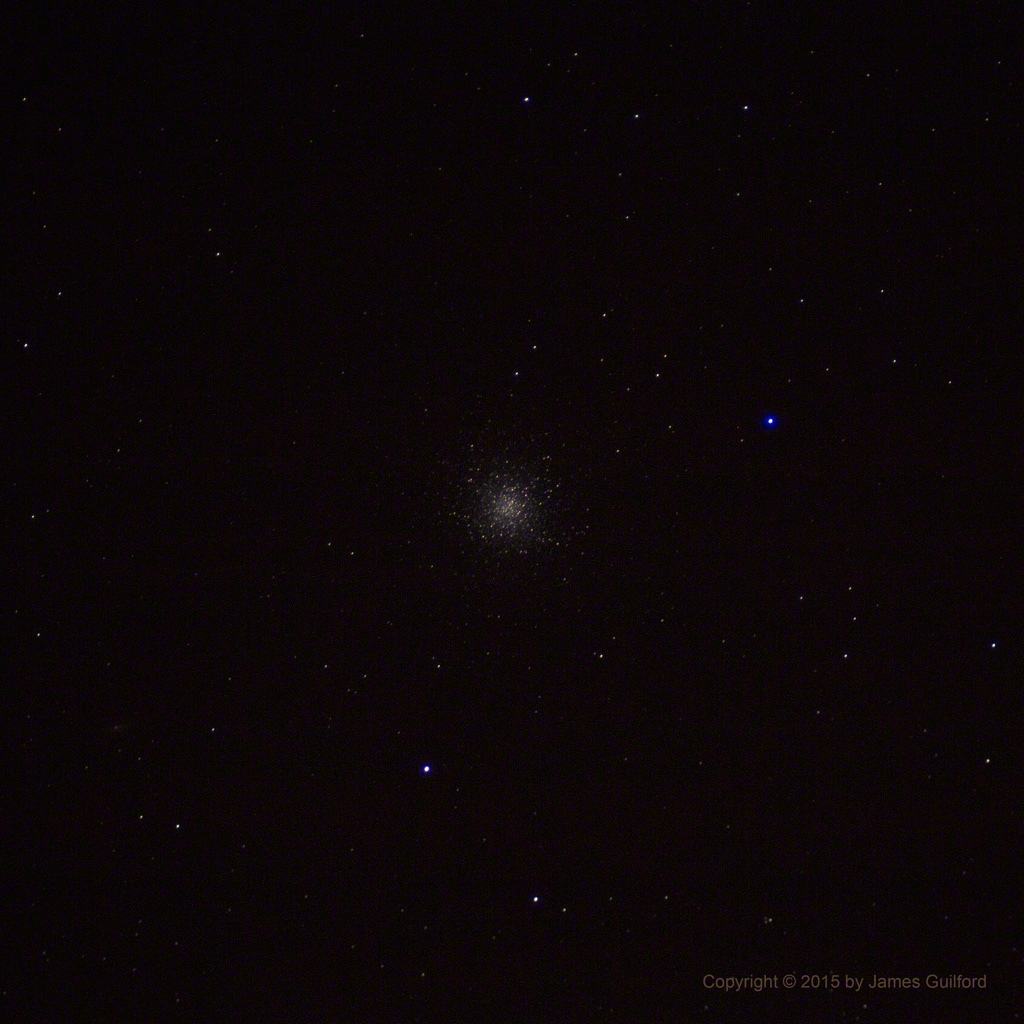
The Hercules Globular Cluster - M13 Through a Small Telescope. Photo by James Guilford.
The Hercules Globular Cluster – M13 Through a Small Telescope – Click to Enlarge

The Hercules star cluster is one of the telescopic gems of the night sky. It is located in the constellation Hercules. Even in relatively small telescopes, the cluster’s appearance in the eyepiece is that of a globe of diamonds on black velvet. The cluster was discovered by Edmond Halley (of comet fame) in 1714, and is also known as M13, as cataloged by Charles Messier in 1764. M13 is a globular cluster, so designated because of its spherical or globe shape, and is composed of about 300,000 stars, 25,100 light-years from Earth. The stars in a globular cluster are of about the same age, having formed together from the same molecular cloud. The photograph shown here illustrates M13 as it may appear to the eye through the eyepiece of a small telescope — click on the image to enlarge. While larger telescopes and sophisticated imaging techniques reveal still greater detail and beauty in the Hercules Globular Cluster, it remains impressive without those enhancements.

Former Observatory Director Robert Andress, Jr.

Photo: Robert Andress, Jr.
Robert “Bob” Andress, Jr. During a Visit to Stephens in 2008

We have received word that Robert Andress, Jr., former director of the Stephens Memorial Observatory, died on May 11, 2015. He was a 1953 graduate of Hiram College and active in astronomy for most of his life. Andress touched many lives as he conducted observatory sessions for the public and for college classes for many years.

Of his time at Hiram, Andress once wrote, “I found that Hiram College had a nice little observatory with a 9-inch refractor and that it was not being used. I found the keys at the college registrar’s office and became the ‘director’, tour guide, and custodian for 28 years. The observatory was a non-paying job except for free admission to plays, concerts and athletics at the college but it led to another job that did pay well in dollars and satisfaction. In 1969 I became the Director of the Planetarium for Warrensville City schools in Warrensville Heights, Ohio….”

Andress was born in Easton, Penn., on October 14, 1931. He served for 21 months in the U.S. Army. He married Lois in April 1954, and had three daughters, Nancy Lindelof, Barbara Andress and Sally Magargee; as well as 11 grandchildren, and seven great-grandchildren. He taught for 30 years, grades 7-8, high school, and some at Hiram College.

Upon retirement, Andress moved from Ohio to Green Valley, Arizona where he was very active in the Sonora Astronomical Society and continued other astronomical pursuits. He reportedly retired as a planetarium director in 2010. We last saw him in Hiram during Alumni Weekend about two years ago when he visited the Observatory for what was to sadly be the last time.

Associates in Arizona informed us that no funeral service was held, “…(the) understanding is that he wanted everything done quietly.”

Photo: Robert Andress, Jr. with an Observatory Visitor.
Robert Andress, Jr. with an Observatory Visitor During a 1975 Meeting of the Great Lakes Planetarium Association.