Stephens Memorial Observatory of Hiram College will be open to the public on Saturday, July 25, from 9:30 to 11:00 PM. On the observing list for the night are: the Moon, ringed world Saturn, and star cluster M4 in Scorpius.
No reservations are required and there is no admission fee for observatory public nights. Cloudy skies at the starting time cancel the event and, in that case, the observatory will not open.
The Observatory is located on Wakefield Road (Rt. 82) less than a quarter of a mile west of Route 700 in Hiram. There is no parking at the Observatory. Visitors may park on permissible side streets near the Post Office, a short distance east of the observatory.
Portrait of a Mysterious World – Credits: NASA/APL/SwRI
Pluto nearly fills the frame in this image from the Long Range Reconnaissance Imager (LORRI) aboard NASA’s New Horizons spacecraft, taken on July 13, 2015 when the spacecraft was 476,000 miles (768,000 kilometers) from the surface. This is the last and most detailed image sent to Earth before the spacecraft’s closest approach to Pluto on July 14. The color image has been combined with lower-resolution color information from the Ralph instrument that was acquired earlier on July 13. This view is dominated by the large, bright feature informally named the “heart,” which measures approximately 1,000 miles (1,600 kilometers) across. The heart borders darker equatorial terrains, and the mottled terrain to its east (right) are complex. However, even at this resolution, much of the heart’s interior appears remarkably featureless — possibly a sign of ongoing geologic processes.
After a decade-long journey through our solar system, New Horizons made its closest approach to Pluto Tuesday, about 7,750 miles above the surface making it the first-ever space mission to explore a world so far from Earth. The three-billion-mile journey took about one minute less than predicted when the craft was launched in January 2006. The spacecraft threaded the needle through a 36-by-57 mile (60 by 90 kilometers) window in space — the equivalent of a commercial airliner arriving no more off target than the width of a tennis ball.
Clyde Tombaugh
The Pluto story began only a generation ago when young Clyde Tombaugh was tasked to look for Planet X, theorized to exist beyond the orbit of Neptune. He discovered a faint point of light that we now see as a complex and fascinating world. As a tribute to Tombaugh, who died in 1997 at age 90, a tiny canister of his ashes was placed inside the New Horizons spacecraft.
“Pluto was discovered just 85 years ago by a farmer’s son from Kansas, inspired by a visionary from Boston, using a telescope in Flagstaff, Arizona,” said John Grunsfeld, associate administrator for NASA’s Science Mission Directorate in Washington. “Today, science takes a great leap observing the Pluto system up close and flying into a new frontier that will help us better understand the origins of the solar system.”
New Horizons’ flyby of the dwarf planet and its five known moons is providing an up-close introduction to the solar system’s Kuiper Belt, an outer region populated by icy objects ranging in size from boulders to dwarf planets. Kuiper Belt objects, such as Pluto, preserve evidence about the early formation of the solar system.
Jupiter and Venus Converge June 30 – Chart Courtesy Sky & Telescope
Let’s hope for clear skies the evening of June 30 when the ongoing conjunction of Jupiter and Venus gets really cozy! Tuesday evening will see the two planets sharing a space only 1/3-degree apart in our sky; they will look like a brilliant double star. After Tuesday’s encounter, the planets will drift slowly apart night-by-night but will remain a beautiful sight in twilight. Chart courtesy Sky & Telescope – SkyAndTelescope.com
UPDATE:As it turned out, although the skies turned cloudy just as the observatory opened for the night, the overcast cleared in short order giving way to very good seeing! About 20 visitors came and enjoyed views of Saturn, its moons, and the Cassini Division within the ring system, the beautiful Hercules Globular Cluster (M13), and Messier 57 aka: the Ring Nebula. Our views of M57 were the best we have enjoyed from Hiram thanks to an eyepiece on loan for testing! Next Open Night is set for July 25.
The title to this posting ought to include a question mark! So far this year, the weather has been very uncooperative on our public Open Nights and Saturday’s forecast doesn’t look very promising. We shall hope for the best because our June 20 event features the beautiful ringed world Saturn. We also hope to spy the Ring Nebula and, to break the ring theme, the diamond-dust Hercules Globular Cluster (M13). If the skies are clear enough, we will be open from 9:30 to 11:00 PM Saturday. The Observatory is located on Wakefield Road (Rt. 82) less than a quarter of a mile west of Route 700 in Hiram. There is no parking at the Observatory. Visitors may park on permissible side streets near the Post Office, a short distance east of the observatory. No reservations are required and there is no admission fee for observatory public nights. Cloudy skies at the starting time cancel the event and, in that case, the observatory will not open. For updates and more information, return here or follow “@StephensObs” on Twitter.
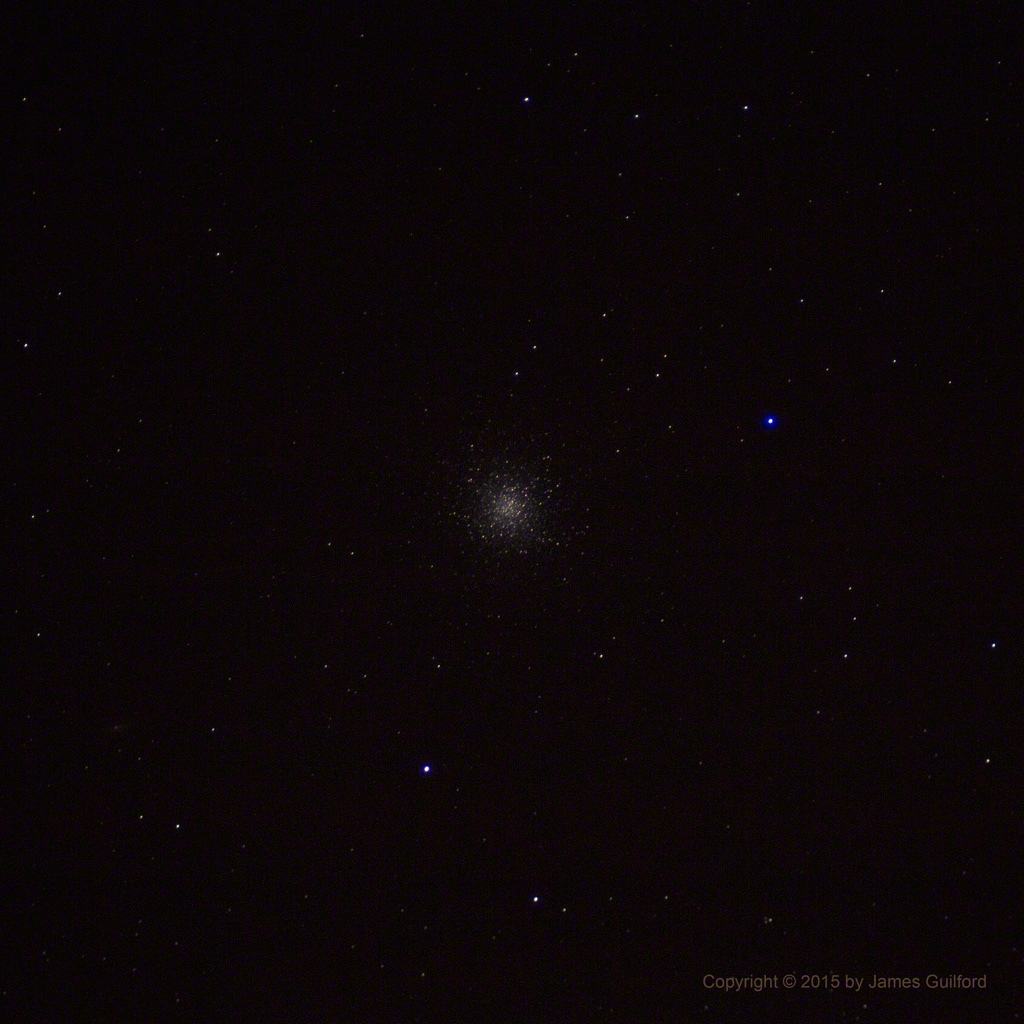
The Hercules Globular Cluster – M13 Through a Small Telescope – Click to Enlarge
The Hercules star cluster is one of the telescopic gems of the night sky. It is located in the constellation Hercules. Even in relatively small telescopes, the cluster’s appearance in the eyepiece is that of a globe of diamonds on black velvet. The cluster was discovered by Edmond Halley (of comet fame) in 1714, and is also known as M13, as cataloged by Charles Messier in 1764. M13 is a globular cluster, so designated because of its spherical or globe shape, and is composed of about 300,000 stars, 25,100 light-years from Earth. The stars in a globular cluster are of about the same age, having formed together from the same molecular cloud. The photograph shown here illustrates M13 as it may appear to the eye through the eyepiece of a small telescope — click on the image to enlarge. While larger telescopes and sophisticated imaging techniques reveal still greater detail and beauty in the Hercules Globular Cluster, it remains impressive without those enhancements.
Robert “Bob” Andress, Jr. During a Visit to Stephens in 2008
We have received word that Robert Andress, Jr., former director of the Stephens Memorial Observatory, died on May 11, 2015. He was a 1953 graduate of Hiram College and active in astronomy for most of his life. Andress touched many lives as he conducted observatory sessions for the public and for college classes for many years.
Of his time at Hiram, Andress once wrote, “I found that Hiram College had a nice little observatory with a 9-inch refractor and that it was not being used. I found the keys at the college registrar’s office and became the ‘director’, tour guide, and custodian for 28 years. The observatory was a non-paying job except for free admission to plays, concerts and athletics at the college but it led to another job that did pay well in dollars and satisfaction. In 1969 I became the Director of the Planetarium for Warrensville City schools in Warrensville Heights, Ohio….”
Andress was born in Easton, Penn., on October 14, 1931. He served for 21 months in the U.S. Army. He married Lois in April 1954, and had three daughters, Nancy Lindelof, Barbara Andress and Sally Magargee; as well as 11 grandchildren, and seven great-grandchildren. He taught for 30 years, grades 7-8, high school, and some at Hiram College.
Upon retirement, Andress moved from Ohio to Green Valley, Arizona where he was very active in the Sonora Astronomical Society and continued other astronomical pursuits. He reportedly retired as a planetarium director in 2010. We last saw him in Hiram during Alumni Weekend about two years ago when he visited the Observatory for what was to sadly be the last time.
Associates in Arizona informed us that no funeral service was held, “…(the) understanding is that he wanted everything done quietly.”
Robert Andress, Jr. with an Observatory Visitor During a 1975 Meeting of the Great Lakes Planetarium Association.
Our Sun is just past the peak of its 11-year activity cycle but has been unusually quiet of late. Many days we have seen few, if any, sunspots marking the star’s face. Over the past few days, however, there has been an uptick in activity including the passage of large sunspot region AR2339 (lower-right in our photo). The sunspot has been the source of major solar flares including one that interfered with radio communications in the Pacific region. This image is a single exposure made using a digital SLR camera held to the eyepiece of the Cooley Telescope at Stephens Memorial Observatory. A white-light filter was used for the protection of equipment and vision. A good article on the current solar cycle can be found here.
UPDATE: Due to severe and inclement weather the scheduled May 30 Open Night has been canceled. Severe thunderstorms were reported in northern portions of Portage County along with strong winds and heavy rains. Radar was tracking other storms expected to reach the Hiram area.
Stephens Memorial Observatory of Hiram College will be open to the public on Saturday, May 30, from 9:00 to 11:00 PM. On the observing list for the night are: the Moon, star cluster M13 in Hercules, and, later, the Ring Nebula. No reservations are required and there is no admission fee for observatory public nights. Cloudy skies at the starting time cancel the event and, in that case, the observatory will not open. The Observatory is located on Wakefield Road (Rt. 82) less than a quarter of a mile west of Route 700 in Hiram. There is no parking at the Observatory. Visitors may park on permissible side streets near the Post Office, a short distance east of the observatory. Watch for updates here and via Twitter @StephensAstro for the latest.
Tonight’s Not-Quite-Full Moon. The Moon will reach its full phase in a little over 24 hours but that doesn’t mean it wasn’t big, bright, and beautiful Saturday night (May 2, 2015)! Phase in this photo is Waxing Gibbous with about 99% illumination … notice the shadowy edge along the bottom-left.
For the first time, images from NASA’s New Horizons spacecraft are revealing bright and dark regions on the surface of faraway Pluto – the primary target of the New Horizons close flyby in mid-July.
Click for Full-Size View – Credits: NASA/JHU-APL/SwRI
The images were captured in early to mid-April from within 70 million miles (113 million kilometers), using the telescopic Long-Range Reconnaissance Imager (LORRI) camera on New Horizons. A technique called image deconvolution sharpens the raw, unprocessed images beamed back to Earth. New Horizons scientists interpreted the data to reveal the dwarf planet has broad surface markings – some bright, some dark – including a bright area at one pole that may be a polar cap.
“As we approach the Pluto system we are starting to see intriguing features such as a bright region near Pluto’s visible pole, starting the great scientific adventure to understand this enigmatic celestial object,” says John Grunsfeld, associate administrator for NASA’s Science Mission Directorate in Washington. “As we get closer, the excitement is building in our quest to unravel the mysteries of Pluto using data from New Horizons.”
Also captured in the images is Pluto’s largest moon, Charon, rotating in its 6.4-day long orbit. The exposure times used to create this image set – a tenth of a second – were too short for the camera to detect Pluto’s four much smaller and fainter moons.
Since it was discovered in 1930, Pluto has remained an enigma. It orbits our sun more than 3 billion miles (about 5 billion kilometers) from Earth, and researchers have struggled to discern any details about its surface. These latest New Horizons images allow the mission science team to detect clear differences in brightness across Pluto’s surface as it rotates.
“After traveling more than nine years through space, it’s stunning to see Pluto, literally a dot of light as seen from Earth, becoming a real place right before our eyes,” said Alan Stern, New Horizons principal investigator at Southwest Research Institute in Boulder, Colorado. “These incredible images are the first in which we can begin to see detail on Pluto, and they are already showing us that Pluto has a complex surface.”
The images the spacecraft returns will dramatically improve as New Horizons speeds closer to its July rendezvous with Pluto.
“We can only imagine what surprises will be revealed when New Horizons passes approximately 7,800 miles (12,500 kilometers) above Pluto’s surface this summer,” said Hal Weaver, the mission’s project scientist at the Johns Hopkins University Applied Physics Laboratory (APL) in Laurel, Maryland.








 Stephens Memorial Observatory