January 2016: Five Planets Visible in the Pre-Dawn Sky
Over recent weeks we have watched as several planets have appeared close together in our morning sky — when clear, that is — and even seen them shift their positions as the days passed! Beginning this frigid week and continuing into mid-February, five of Earth’s Solar System siblings will be visible, spanning the southern sky. This is the first time since 2005 that this planetary lineup has occurred. If we get a break in morning cloud cover go out, just before dawn’s early light, and look for the planetary parade. Little Mercury will be the hardest to spot being both dim and close to the horizon. Venus and Jupiter will be easy as they are the brightest of the bunch. Golden Saturn and finally reddish Mars should also be easy to find though Mars isn’t a standout. The gathering will occur again late this summer and in the evening sky. The planets aren’t really very much closer together in space during this time. The chart below illustrates the current relative positions of the planets; it’s our point of view from Earth that makes creates the scene: something like watching racers on a race track, appearing closer and farther apart as they run laps in their concentric lanes.
January 2016: Planetary Positions – Area Between Lines of Sight Illustrates Area of Space We See
Detail of Earth’s Moon viewed through The Cooley Telescope
UPDATE: Braving the cold (temperatures in the mid-20s), 17 folks visited the observatory and all were treated to our usual outstanding views of our Moon. Determined by timing and other factors, visitors also saw combinations of other objects: Uranus, stars of the Pleiades and Hyades star clusters, and the delicate beauty of the Orion Nebula.
Stephens Memorial Observatory of Hiram College will be open to the public on Saturday, December 19, from 7:00 to 9:00 PM. The Moon and planet Uranus, and the Pleiades and Hyades star clusters are to be featured during this, the final observatory event for the year. Visitors should bundle up; the observatory is unheated and Saturday’s forecast calls for frigid temperatures!
No reservations are required and there is no admission fee for observatory public nights. Cloudy skies at the starting time cancel the event and, in that case, the observatory will not open.
The Observatory is located on Wakefield Road (Rt. 82) less than a quarter of a mile west of Route 700 in Hiram. There is no parking at the Observatory. Visitors may park on permissible side streets near the Post Office, a short distance east of the observatory.
An impressive train of sunspots has been making its way across the face of our nearest star this week. In the photo above: Designated AR2447 (small group to the left), AR2443 (bigger and darker, near center), and AR2445 (far right), the “Active Regions” have the potential of unleashing flares. In fact, AR2445 was the source of a flare that caused this week’s “northern lights” sighted across northern latitude locations around the world. Now rotating over the Sun’s limb, AR2445 won’t be aimed at Earth for a while — if ever again — but AR2443 has potential for high-energy flares.
Photo credit: James Guilford. Canon EOS 7D II: ISO 400, f/11, 1/1250 sec., 400mm lens with Astrozap film solar filter, heavily cropped, November 4, 2015, 2:22 PM.
UPDATE: Due to cloud cover and inclement weather, this program has been canceled; the observatory WILL NOT be open.
The Pleiades – Messier 45
Stephens Memorial Observatory of Hiram College will be open to the public on Saturday, November 21, from 7:00 to 9:00 PM. On the observing list for the night are: the Moon, the Pleiades and Hyades star clusters, and possibly other celestial objects.
No reservations are required and there is no admission fee for observatory public nights. Cloudy skies at the starting time cancel the event and, in that case, the observatory will not open. For updates and more information, return here or follow “@StephensObs” on Twitter.
The Observatory is located on Wakefield Road (Rt. 82) less than a quarter of a mile west of Route 700 in Hiram. There is no parking at the Observatory. Visitors may park on permissible side streets near the Post Office, a short distance east of the observatory.
Preparing for this week’s expected heavy rains and wind, I went to the roof of the observatory to clean out the rain gutters and check the downspouts. Chores done and with the dome open, I made another experiment at solar imaging through the big vintage Cooley Telescope. I found I could focus on the Sun (through a safe solar filter) and, with a Canon DSLR camera at the telescope’s prime focus, recorded a few one-shot images at ISO 400 and 1/500 second. The telescope is a 9-inch refractor with a focal length of 3,327mm. The results appear better than last time but show the apparent effect of atmospheric turbulence: that’s my story and I’m sticking with it! A few sunspots were visible and details of Sol’s roiling atmosphere show up. The photographic technique is the simplest we can use; more sophisticated processes are employed these days to achieve best results. Still, proof of concept is a good thing and getting the image focused is a critical step. I think next time we may try a dimmer subject.
This image from the NASA/ESA Hubble Space Telescope shows the galaxy cluster MACSJ0717.5+3745. This is one of six being studied by the Hubble Frontier Fields programme, which together have produced the deepest images of gravitational lensing ever made. Due to the huge mass of the cluster it is bending the light of background objects, acting as a magnifying lens. It is one of the most massive galaxy clusters known, and it is also the largest known gravitational lens. Of all of the galaxy clusters known and measured, MACS J0717 lenses the largest area of the sky.
Observations by the NASA/ESA Hubble Space Telescope have taken advantage of gravitational lensing to reveal the largest sample of the faintest and earliest known galaxies in the Universe. Some of these galaxies formed just 600 million years after the Big Bang and are fainter than any other galaxy yet uncovered by Hubble. The team has determined, for the first time with some confidence, that these small galaxies were vital to creating the Universe that we see today.
An international team of astronomers, led by Hakim Atek of the Ecole Polytechnique Fédérale de Lausanne, Switzerland, has discovered over 250 tiny galaxies that existed only 600 to 900 million years after the Big Bang — one of the largest samples of dwarf galaxies yet to be discovered at these epochs. The light from these galaxies took over 12 billion years to reach the telescope, allowing the astronomers to look back in time when the universe was still very young.
Although impressive, the number of galaxies found at this early epoch is not the team’s only remarkable breakthrough, as Johan Richard from the Observatoire de Lyon, France, points out, “The faintest galaxies detected in these Hubble observations are fainter than any other yet uncovered in the deepest Hubble observations.”
By looking at the light coming from the galaxies the team discovered that the accumulated light emitted by these galaxies could have played a major role in one of the most mysterious periods of the Universe’s early history — the epoch of reionization. Reionization started when the thick fog of hydrogen gas that cloaked the early Universe began to clear. Ultraviolet light was now able to travel over larger distances without being blocked and the Universe became transparent to ultraviolet light.
By observing the ultraviolet light from the galaxies found in this study the astronomers were able to calculate whether these were in fact some of the galaxies involved in the process. The team determined, for the first time with some confidence, that the smallest and most abundant of the galaxies in the study could be the major actors in keeping the Universe transparent. By doing so, they have established that the epoch of reionization — which ends at the point when the Universe is fully transparent — came to a close about 700 million years after the Big Bang.
Lead author Atek explained, “If we took into account only the contributions from bright and massive galaxies, we found that these were insufficient to reionize the Universe. We also needed to add in the contribution of a more abundant population of faint dwarf galaxies.”
To make these discoveries, the team utilized the deepest images of gravitational lensing made so far in three galaxy clusters, which were taken as part of the Hubble Frontier Fields program. These clusters generate immense gravitational fields capable of magnifying the light from the faint galaxies that lie far behind the clusters themselves. This makes it possible to search for, and study, the first generation of galaxies in the Universe.
Jean-Paul Kneib, co-author of the study from the Ecole Polytechnique Fédérale de Lausanne, Switzerland, explains, “Clusters in the Frontier Fields act as powerful natural telescopes and unveil these faint dwarf galaxies that would otherwise be invisible.”
Co-author of the study Mathilde Jauzac, from Durham University, UK, and the University of KwaZulu-Natal, South Africa, remarks on the significance of the discovery and Hubble’s role in it,“Hubble remains unrivaled in its ability to observe the most distant galaxies. The sheer depth of the Hubble Frontier Field data guarantees a very precise understanding of the cluster magnification effect, allowing us to make discoveries like these.”
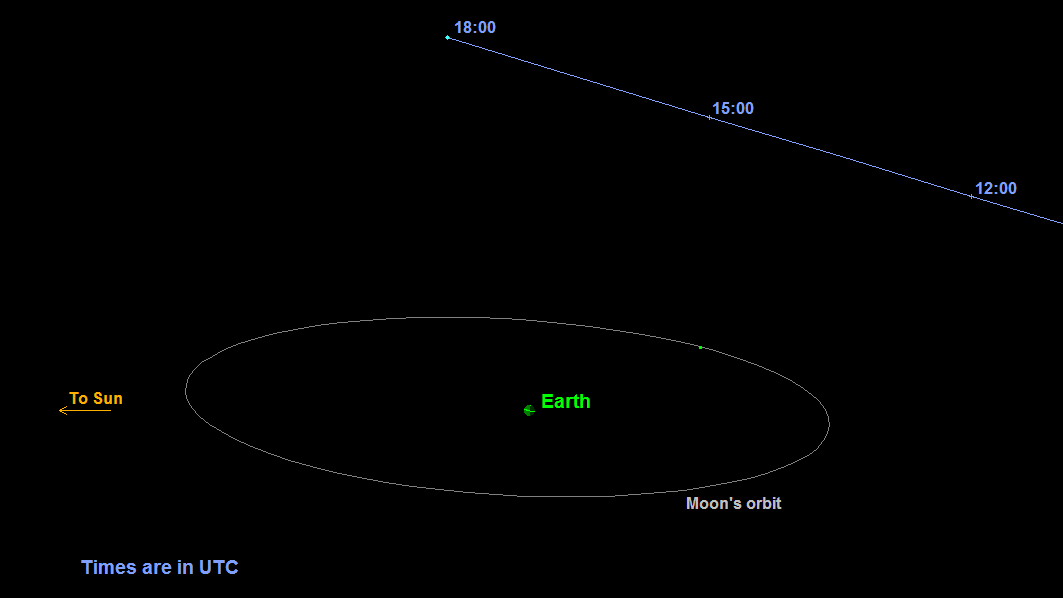
This is a graphic depicting the orbit of asteroid 2015 TB145. The asteroid will safely fly past Earth slightly farther out than the moon’s orbit on Oct. 31 at 10:05 a.m. Pacific (1:05 p.m. EDT and 17:05 UTC). Image credit: NASA/JPL-Caltech
NASA scientists are tracking the upcoming Halloween flyby of asteroid 2015 TB145 with several optical observatories and the radar capabilities of the agency’s Deep Space Network at Goldstone, California. The asteroid will fly past Earth at a safe distance slightly farther than the moon’s orbit on Oct. 31 at 1:05 PM EDT. Scientists are treating the flyby of the estimated 1,300-foot-wide asteroid as a science target of opportunity, allowing instruments on “spacecraft Earth” to scan it during the close pass.
Asteroid 2015 TB145 was discovered on Oct. 10, 2015, by the University of Hawaii’s Pan-STARRS-1 (Panoramic Survey Telescope and Rapid Response System) on Haleakala, Maui, part of the NASA-funded Near-Earth Object Observation (NEOO) Program. According to the catalog of near-Earth objects (NEOs) kept by the Minor Planet Center, this is the closest currently known approach by an object this large until asteroid 1999 AN10, at about 2,600 feet in size, approaches at about 238,000 miles from Earth in August 2027.
“The trajectory of 2015 TB145 is well understood,” said Paul Chodas, manager of the Center for Near Earth Object Studies at NASA’s Jet Propulsion Laboratory, Pasadena, California. “At the point of closest approach, it will be no closer than about 300,000 miles — 480,000 kilometers or 1.3 lunar distances. Even though that is relatively close by celestial standards, it is expected to be fairly faint, so night-sky Earth observers would need at least a small telescope to view it.”
The gravitational influence of the asteroid is so small it will have no detectable effect on the moon or anything here on Earth, including our planet’s tides or tectonic plates.
The Center for NEO Studies at JPL is a central node for NEO data analysis in NASA’s Near-Earth Object Observation Program and a key group involved with the international collaboration of astronomers and scientists who keep watch on the sky with their telescopes, looking for asteroids that could be a hazard to impact our planet and predicting their paths through space for the foreseeable future.
“The close approach of 2015 TB145 at about 1.3 times the distance of the moon’s orbit, coupled with its size, suggests it will be one of the best asteroids for radar imaging we’ll see for several years,” said Lance Benner, of JPL, who leads NASA’s asteroid radar research program. “We plan to test a new capability to obtain radar images with two-meter resolution for the first time and hope to see unprecedented levels of detail.”
During tracking, scientists will use the 110-foot DSS 13 antenna at Goldstone to bounce radio waves off the asteroid. Radar echoes will in turn be collected by the National Radio Astronomy Observatory’s Green Bank Telescope in Green Bank, West Virginia, and the National Astronomy and Ionosphere Center’s Arecibo Observatory, Puerto Rico. NASA scientists hope to obtain radar images of the asteroid as fine as about seven feet per pixel. This should reveal a wealth of detail about the object’s surface features, shape, dimensions and other physical properties.
“The asteroid’s orbit is very oblong with a high inclination to below the plane of the solar system,” said Benner. “Such a unique orbit, along with its high encounter velocity — about 22 miles per second — raises the question of whether it may be some type of comet. If so, then this would be the first time that the Goldstone radar has imaged a comet from such a close distance.”
NASA’s Near-Earth Object Observations Program detects, tracks and characterizes asteroids and comets passing within 30 million miles of Earth using both ground- and space-based telescopes. The NEOO Program, sometimes called “Spaceguard,” discovers these objects, characterizes the physical nature of a subset of them, and predicts their paths to determine if any could be potentially hazardous to our planet. There are no known credible impact threats to date — only the ongoing and harmless in-fall of meteoroids, tiny asteroids that burn up in the atmosphere.
UPDATE: Due to cloud cover and inclement weather, this program has been canceled; the observatory WILL NOT be open.
Stephens Memorial Observatory of Hiram College will be open to the public on Saturday, October 17, from 8:00 to 10:00 PM. On the observing list for the night are: the Andromeda Galaxy, the Perseus Double Cluster, and possibly other celestial objects.
No reservations are required and there is no admission fee for observatory public nights. Cloudy skies at the starting time cancel the event and, in that case, the observatory will not open. For updates and more information, see this website or follow our Tweets: http://twitter.com/StephensObs
If local conditions don’t allow viewing tonight’s total lunar eclipse or if you just can’t get out, try one of the several live webcasts. Seeing the eclipse would be much better “in person,” but watching via computer or TV is better than nothing!
UPDATE:ECLIPSE WATCH EVENT CANCELED: Due to very poor sky conditions we feel must CANCEL tonight’s planned lunar eclipse watch and stargazing event. Forecasts call for occasional breaks in the overcast but their expected rarity and random nature would make for a poor viewing experience. Rain chances increase at about the time when the eclipse reaches maximum. Since the eclipse can be viewed without the use of a telescope, checking the skies for occasional breaks would be wise. Use the eclipse timing chart below to check the sky at critical points. Still want to see the eclipse, even if it’s via computer, tablet, or television? Check this item for resources!
SPECIAL PUBLIC EVENT: VIEWING THE TOTAL LUNAR ECLIPSE. This public observing event will take place at the Hiram Village playing field, across from the Municipal Building and behind the Hiram Historical Society. Hours are 8:30 to 12:30. There is no fee and no reservations are required. Attendees may come and go at will — see timing chart below. Click here for Google Maps. The Observatory will NOT be open for this event.
During the eclipse we plan to have one or more telescopes available for viewing of the Moon and, as the sky darkens, visible stars, planets, and other wonders of the night sky. This is an outdoor event so visitors should dress accordingly; flashlights will help find the way but please point downward so as not to spoil others’ night vision. Of course, inclement weather or overcast skies will cancel our viewing of the eclipse. Special thanks to Mayor Lou Bertrand and the Village of Hiram for allowing our nighttime use of the playing field.
On the night of September 27, 2015 Earth’s shadow will cross the face of its Moon and viewers across North America will be treated to a total lunar eclipse. We, in Northeastern Ohio, are in luck this time as the entire eclipse will be visible to us and in “prime time” — a marvelous and relatively rare situation! Click here for a printable event flyer.
As the partial phase of the eclipse begins, at 9:07 PM, viewers will see the Full Moon gradually covered by the dark portion of Earth’s shadow. As the Moon moves deeper into shadow it will begin to glow a copper-red until at totality,10:11 PM, Luna will hang colorfully in our star-sprinkled sky. As the eclipse ends, the process reverses until in the wee hours of Monday, the Full Moon will brightly shine again. Click here for a detailed, somewhat technical chart.
If you cannot join us for the public event, use the table below and watch from your back yard — you don’t even need a telescope! All you need is to be able to see the Moon and we’ll all hope for clear skies!
Please note that, on the Web and in the media, there may be confusion over the time and date of the eclipse event. The table above is correct for our Northern Ohio location.




 Stephens Memorial Observatory