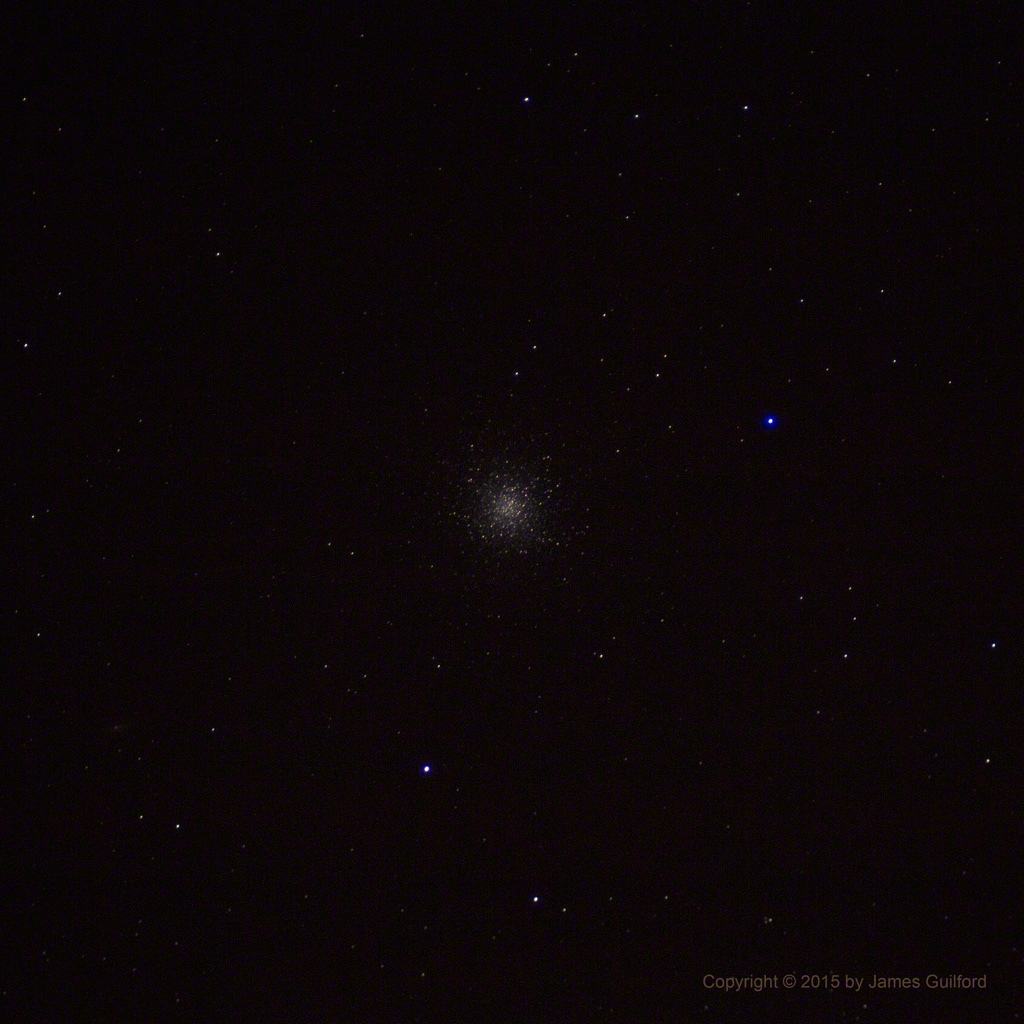
The Hercules Globular Cluster – M13 Through a Small Telescope – Click to Enlarge
The Hercules star cluster is one of the telescopic gems of the night sky. It is located in the constellation Hercules. Even in relatively small telescopes, the cluster’s appearance in the eyepiece is that of a globe of diamonds on black velvet. The cluster was discovered by Edmond Halley (of comet fame) in 1714, and is also known as M13, as cataloged by Charles Messier in 1764. M13 is a globular cluster, so designated because of its spherical or globe shape, and is composed of about 300,000 stars, 25,100 light-years from Earth. The stars in a globular cluster are of about the same age, having formed together from the same molecular cloud. The photograph shown here illustrates M13 as it may appear to the eye through the eyepiece of a small telescope — click on the image to enlarge. While larger telescopes and sophisticated imaging techniques reveal still greater detail and beauty in the Hercules Globular Cluster, it remains impressive without those enhancements.
Robert “Bob” Andress, Jr. During a Visit to Stephens in 2008
We have received word that Robert Andress, Jr., former director of the Stephens Memorial Observatory, died on May 11, 2015. He was a 1953 graduate of Hiram College and active in astronomy for most of his life. Andress touched many lives as he conducted observatory sessions for the public and for college classes for many years.
Of his time at Hiram, Andress once wrote, “I found that Hiram College had a nice little observatory with a 9-inch refractor and that it was not being used. I found the keys at the college registrar’s office and became the ‘director’, tour guide, and custodian for 28 years. The observatory was a non-paying job except for free admission to plays, concerts and athletics at the college but it led to another job that did pay well in dollars and satisfaction. In 1969 I became the Director of the Planetarium for Warrensville City schools in Warrensville Heights, Ohio….”
Andress was born in Easton, Penn., on October 14, 1931. He served for 21 months in the U.S. Army. He married Lois in April 1954, and had three daughters, Nancy Lindelof, Barbara Andress and Sally Magargee; as well as 11 grandchildren, and seven great-grandchildren. He taught for 30 years, grades 7-8, high school, and some at Hiram College.
Upon retirement, Andress moved from Ohio to Green Valley, Arizona where he was very active in the Sonora Astronomical Society and continued other astronomical pursuits. He reportedly retired as a planetarium director in 2010. We last saw him in Hiram during Alumni Weekend about two years ago when he visited the Observatory for what was to sadly be the last time.
Associates in Arizona informed us that no funeral service was held, “…(the) understanding is that he wanted everything done quietly.”
Robert Andress, Jr. with an Observatory Visitor During a 1975 Meeting of the Great Lakes Planetarium Association.
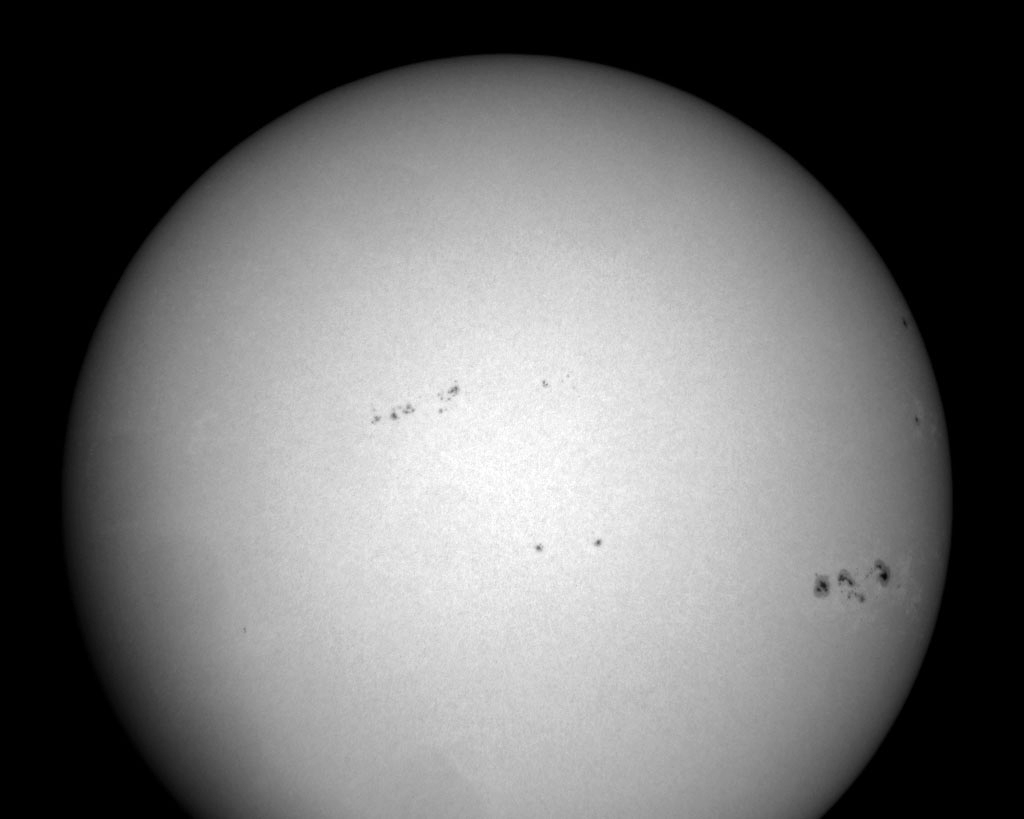
Our Sun is just past the peak of its 11-year activity cycle but has been unusually quiet of late. Many days we have seen few, if any, sunspots marking the star’s face. Over the past few days, however, there has been an uptick in activity including the passage of large sunspot region AR2339 (lower-right in our photo). The sunspot has been the source of major solar flares including one that interfered with radio communications in the Pacific region. This image is a single exposure made using a digital SLR camera held to the eyepiece of the Cooley Telescope at Stephens Memorial Observatory. A white-light filter was used for the protection of equipment and vision. A good article on the current solar cycle can be found here.
Tonight’s Not-Quite-Full Moon. The Moon will reach its full phase in a little over 24 hours but that doesn’t mean it wasn’t big, bright, and beautiful Saturday night (May 2, 2015)! Phase in this photo is Waxing Gibbous with about 99% illumination … notice the shadowy edge along the bottom-left.
For the first time, images from NASA’s New Horizons spacecraft are revealing bright and dark regions on the surface of faraway Pluto – the primary target of the New Horizons close flyby in mid-July.
Click for Full-Size View – Credits: NASA/JHU-APL/SwRI
The images were captured in early to mid-April from within 70 million miles (113 million kilometers), using the telescopic Long-Range Reconnaissance Imager (LORRI) camera on New Horizons. A technique called image deconvolution sharpens the raw, unprocessed images beamed back to Earth. New Horizons scientists interpreted the data to reveal the dwarf planet has broad surface markings – some bright, some dark – including a bright area at one pole that may be a polar cap.
“As we approach the Pluto system we are starting to see intriguing features such as a bright region near Pluto’s visible pole, starting the great scientific adventure to understand this enigmatic celestial object,” says John Grunsfeld, associate administrator for NASA’s Science Mission Directorate in Washington. “As we get closer, the excitement is building in our quest to unravel the mysteries of Pluto using data from New Horizons.”
Also captured in the images is Pluto’s largest moon, Charon, rotating in its 6.4-day long orbit. The exposure times used to create this image set – a tenth of a second – were too short for the camera to detect Pluto’s four much smaller and fainter moons.
Since it was discovered in 1930, Pluto has remained an enigma. It orbits our sun more than 3 billion miles (about 5 billion kilometers) from Earth, and researchers have struggled to discern any details about its surface. These latest New Horizons images allow the mission science team to detect clear differences in brightness across Pluto’s surface as it rotates.
“After traveling more than nine years through space, it’s stunning to see Pluto, literally a dot of light as seen from Earth, becoming a real place right before our eyes,” said Alan Stern, New Horizons principal investigator at Southwest Research Institute in Boulder, Colorado. “These incredible images are the first in which we can begin to see detail on Pluto, and they are already showing us that Pluto has a complex surface.”
The images the spacecraft returns will dramatically improve as New Horizons speeds closer to its July rendezvous with Pluto.
“We can only imagine what surprises will be revealed when New Horizons passes approximately 7,800 miles (12,500 kilometers) above Pluto’s surface this summer,” said Hal Weaver, the mission’s project scientist at the Johns Hopkins University Applied Physics Laboratory (APL) in Laurel, Maryland.
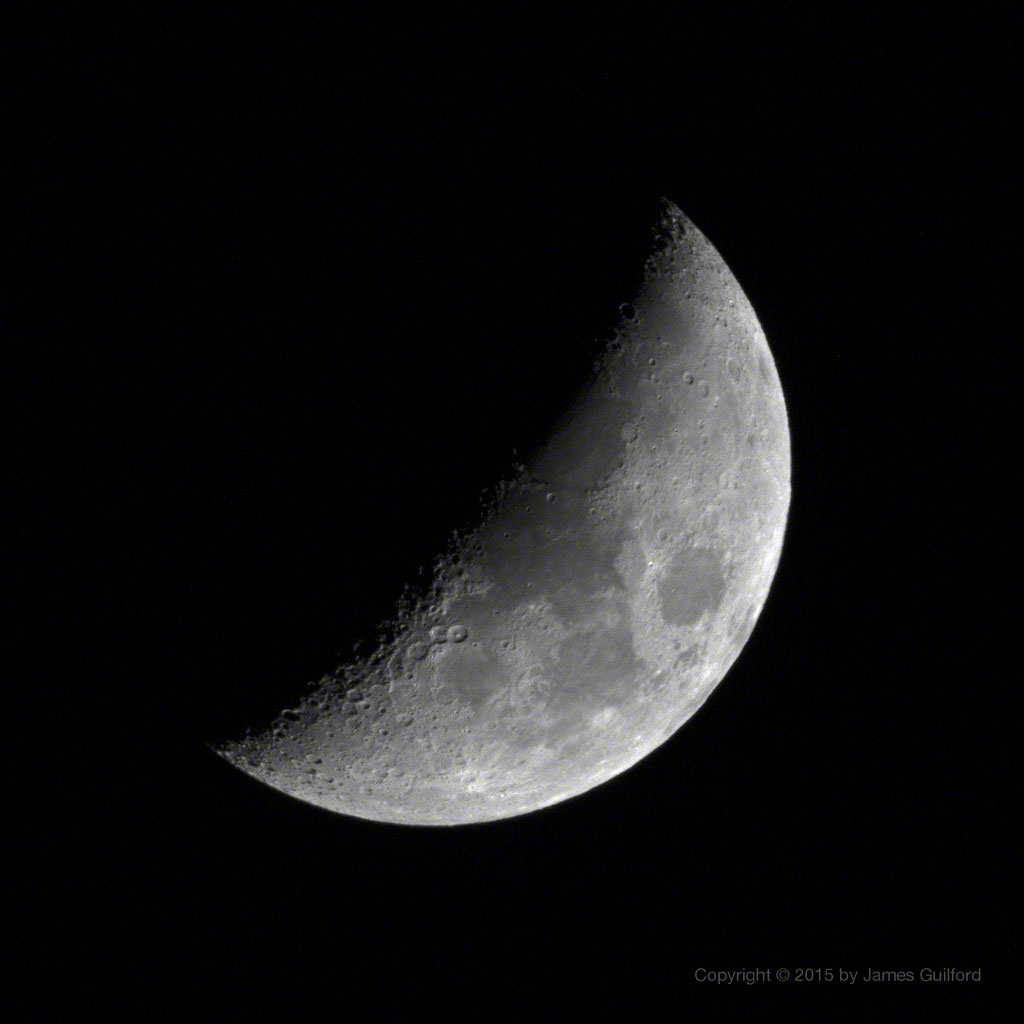
The Waxing Gibbous Moon – Night Before First Quarter
Clear skies look unlikely for our planned Public Open Night scheduled for Saturday. So here’s a look at Friday night’s Moon. I captured this with my camera and a telephoto lens and it turned out pretty well. I must say, however, that visitors viewing Luna through the Observatory’s grand old telescope get a much better view than I’m displaying here! Still, we’ll point out a few things here that we would mention if we were looking through the telescope… First, look along the edge of the Moon’s disk as it is contrasted against the blackness of space; note how it’s a bit uneven? The lumps in the disk’s edge are actually mountains and crater rims on the sides of the Moon’s globe! See the “smile” line on the inner edge of the Moon? That line divides the lit and unlit portions of the Moon and is called the terminator. In this, the waxing gibbous phase, the terminator represents sunrise on the surface. As on Earth, sunrise shadows are long and those long shadows and low-angle sunlight bring out details in the craters and mountains (for even greater detail, see this image from last month). The bright ray-lines projecting from some of the craters are light-colored material “splashed” out of the crater sites as they were formed by asteroid hits; they mark newer craters. Also note the central peak in at least one of the craters – material thrust upward as shock waves from collisions bounded back, inward, from the forming crater walls. Old Luna is full of amazing sights, if only we will see them!
Richmond Hill, ON – In what astronomers might describe as “stellar news,” Corsica Development Inc. is donating the David Dunlap Observatory (DDO) to the facility’s long-time stewards – the Royal Astronomical Society of Canada, Toronto Centre. The observatory is 80 years old this year. It houses what is still the largest optical telescope in the country with a mirror measuring 74 inches (1.9meters) across.
The decision was made in 2012 by Corsica to transfer the Administration Building and Dome to an agency that would honor the spirit of the Observatory and ensure its long-term viability. Members of the RASC Toronto Centre have been managing and operating the David Dunlap Observatory for the last six years and are the resident experts.
Corsica, which purchased the 190 acre Observatory property from the University of Toronto in 2008, is also donating nearly 100 acres of the land to the Town of Richmond Hill.
RASC Toronto Centre has been involved in public outreach programs at the Dunlap Observatory since it first opened in 1935. The registered charity took on full responsibility for the Observatory and Administration building in 2009, including maintaining and operating the largest optical telescope in Canada. “We’re honored by this incredibly generous gift,” says Paul Mortfield, President of RASC Toronto Centre. “Fred DeGasperis was very supportive of our work at the DDO and our commitment as stewards of the Observatory and telescope. We will always be grateful for the confidence he showed in us.”
The historic buildings will continue to be a centre for education and science literacy for the community.
For the last six years RASC Toronto Centre member volunteers have managed the facility and provided hundreds of award-winning educational and outreach programs to York Region families and students. They’ve done so without the use of local tax dollars.
Centre members say they’re looking forward to working collaboratively with the town on new programs and projects that will continue to benefit town residents.
Please see the announcement on www.theDDO.ca for more information.
Stephens Memorial Observatory of Hiram College will be open to the public on Saturday, April 25, from 9:00 to 10:00 PM. On the observing list for the night are: Jupiter, Beehive Cluster, M3 Star Cluster, and the Moon. Cloudy skies cancel the event! Trees to our west may interfere with viewing of both the Moon and Jupiter later in our session, so earlier arrival would be good.
The Observatory is located on Wakefield Road (Rt. 82) less than a quarter of a mile west of Route 700 in Hiram. For updates and more information, see the observatory’s Web site: StephensObservatory.org or “@StephensObs” on Twitter.
No reservations are required and there is no admission fee for observatory public nights. Cloudy skies at the starting time cancel the event and, in that case, the observatory will not open. There is no parking at the Observatory. Visitors may park on permissible side streets near the Post Office, a short distance east of the observatory.
Saturday morning will afford most of North America the opportunity to see a beautiful, if brief, total lunar eclipse; that opportunity does not extend to those of us located in Northeastern Ohio. Our missed opportunity is a matter of location and timing: the partial phase of the eclipse will begin for us at 6:16 AM EDT and the eclipsing Moon will set at 7:10 AM. Sunrise is at 7:05 AM. At best, we will see a shadowy edge missing from the Full Moon as it sinks below the horizon and is obliterated by dawn’s light. We will miss the dramatic “totality” phase entirely.
Eclipse watchers farther west of us will witness the shortest lunar eclipse of the century with totality lasting only about five minutes.
This eclipse marks the third in a series of four lunar eclipses in a row, known as a “tetrad.” The first in the series occurred on April 15, 2014, the second in September of 2014, and the final will be Sept. 27, 2015.
During an eclipse, the moon often looks coppery or reddish because sunlight has passed through Earth’s atmosphere, which filters out most of its blue light. This eerie, harmless effect was understandably frightening to people before its cause was understood.
For a total lunar eclipse to happen, the moon must be Full, which means it is directly opposite the Sun, with Earth in between. The Moon moves into the shadow cast into space by the Sun shining on Earth. An eclipse does not occur every month because sometimes the Moon is above the shadow and sometimes below.
Take heart, Ohioans, for we will have a grand eclipse viewing opportunity later this year! The September 27 total lunar eclipse will take place before midnight and we will be able to witness the entire event, if the skies cooperate!
The Griffith Observatory in Los Angeles will provide a live feed from their telescope starting at 6 AM EDT on April 4:
Welcome to the new online home of Stephens Memorial Observatory! We are moving from our traditional static page website to the WordPress CMS platform. The transition shouldn’t take long but, in the short term, some of the previous content may be missing. Check the page menus to find important items such as our Open Nights schedule and Contact information.







 Stephens Memorial Observatory