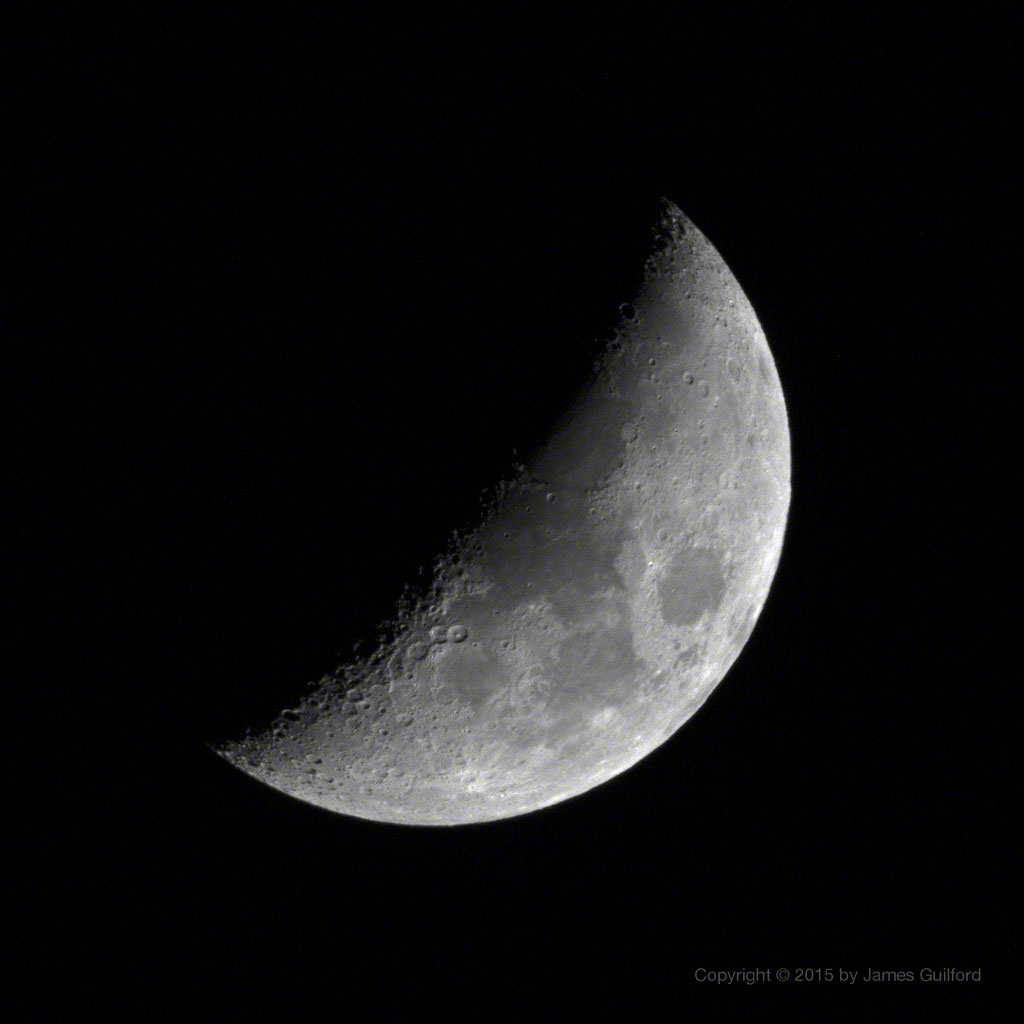
Tonight’s Not-Quite-Full Moon. The Moon will reach its full phase in a little over 24 hours but that doesn’t mean it wasn’t big, bright, and beautiful Saturday night (May 2, 2015)! Phase in this photo is Waxing Gibbous with about 99% illumination … notice the shadowy edge along the bottom-left.
The Waxing Gibbous Moon – Night Before First Quarter
Clear skies look unlikely for our planned Public Open Night scheduled for Saturday. So here’s a look at Friday night’s Moon. I captured this with my camera and a telephoto lens and it turned out pretty well. I must say, however, that visitors viewing Luna through the Observatory’s grand old telescope get a much better view than I’m displaying here! Still, we’ll point out a few things here that we would mention if we were looking through the telescope… First, look along the edge of the Moon’s disk as it is contrasted against the blackness of space; note how it’s a bit uneven? The lumps in the disk’s edge are actually mountains and crater rims on the sides of the Moon’s globe! See the “smile” line on the inner edge of the Moon? That line divides the lit and unlit portions of the Moon and is called the terminator. In this, the waxing gibbous phase, the terminator represents sunrise on the surface. As on Earth, sunrise shadows are long and those long shadows and low-angle sunlight bring out details in the craters and mountains (for even greater detail, see this image from last month). The bright ray-lines projecting from some of the craters are light-colored material “splashed” out of the crater sites as they were formed by asteroid hits; they mark newer craters. Also note the central peak in at least one of the craters – material thrust upward as shock waves from collisions bounded back, inward, from the forming crater walls. Old Luna is full of amazing sights, if only we will see them!
Stephens Memorial Observatory of Hiram College will be open to the public on Saturday, April 25, from 9:00 to 10:00 PM. On the observing list for the night are: Jupiter, Beehive Cluster, M3 Star Cluster, and the Moon. Cloudy skies cancel the event! Trees to our west may interfere with viewing of both the Moon and Jupiter later in our session, so earlier arrival would be good.
The Observatory is located on Wakefield Road (Rt. 82) less than a quarter of a mile west of Route 700 in Hiram. For updates and more information, see the observatory’s Web site: StephensObservatory.org or “@StephensObs” on Twitter.
No reservations are required and there is no admission fee for observatory public nights. Cloudy skies at the starting time cancel the event and, in that case, the observatory will not open. There is no parking at the Observatory. Visitors may park on permissible side streets near the Post Office, a short distance east of the observatory.
Saturday morning will afford most of North America the opportunity to see a beautiful, if brief, total lunar eclipse; that opportunity does not extend to those of us located in Northeastern Ohio. Our missed opportunity is a matter of location and timing: the partial phase of the eclipse will begin for us at 6:16 AM EDT and the eclipsing Moon will set at 7:10 AM. Sunrise is at 7:05 AM. At best, we will see a shadowy edge missing from the Full Moon as it sinks below the horizon and is obliterated by dawn’s light. We will miss the dramatic “totality” phase entirely.
Eclipse watchers farther west of us will witness the shortest lunar eclipse of the century with totality lasting only about five minutes.
This eclipse marks the third in a series of four lunar eclipses in a row, known as a “tetrad.” The first in the series occurred on April 15, 2014, the second in September of 2014, and the final will be Sept. 27, 2015.
During an eclipse, the moon often looks coppery or reddish because sunlight has passed through Earth’s atmosphere, which filters out most of its blue light. This eerie, harmless effect was understandably frightening to people before its cause was understood.
For a total lunar eclipse to happen, the moon must be Full, which means it is directly opposite the Sun, with Earth in between. The Moon moves into the shadow cast into space by the Sun shining on Earth. An eclipse does not occur every month because sometimes the Moon is above the shadow and sometimes below.
Take heart, Ohioans, for we will have a grand eclipse viewing opportunity later this year! The September 27 total lunar eclipse will take place before midnight and we will be able to witness the entire event, if the skies cooperate!
The Griffith Observatory in Los Angeles will provide a live feed from their telescope starting at 6 AM EDT on April 4:
The Moon: Mare Serenitatis (left, Sea of Serenity), half-lit Mare Iridium (right, Sea of Rainbows)
I can’t say as I blame them, the people who didn’t show for our observatory open night Saturday, March 28 — only seven braved the cold. After all, the temperature was about 19° (F), darned cold! But the sky was clear and the waxing Moon was high in the sky. Both Moon and Jupiter were sharing constellation Cancer with The Beehive star cluster (M44). Still, those sensible people who stayed home and warm missed a glorious view of old Luna. In my idle time waiting for visitors, I tried out a little afocal astrophotography using the observatory’s 9-inch Warner and Swasey telescope (ca. 1901) and my little Samsung Galaxy Camera 2 all-in-one. Most shots were a little shy of sharp, and all had some degree of chromatic aberration, and all had a big chunk of image missing where our century-old star diagonal is missing a bit of glass. One shot, however, did work out well, especially after a little fix-up including conversion to monochrome to eliminate color fringing. Not long after the last of our brave visitors left, I caught sight of the indistinct reappearance of Jupiter’s Great Red Spot and that was it… time to close up and go home. My toes needed to be thawed.



 Stephens Memorial Observatory