Juno reaches Jupiter after five-year journey

Image: This illustration depicts NASA's Juno spacecraft at Jupiter, with its solar arrays and main antenna pointed toward the distant sun and Earth. Image Credit: NASA/JPL-Caltech
This illustration depicts NASA’s Juno spacecraft at Jupiter, with its solar arrays and main antenna pointed toward the distant sun and Earth. Image Credit: NASA/JPL-Caltech


NASA’s Juno mission, launched nearly five years ago, will soon reach its final destination: the most massive planet in our solar system, Jupiter. On the evening of July 4, at roughly 9 PM PDT (12 AM EDT, July 5), the spacecraft will complete a burn of its main engine, placing it in orbit around the king of planets.

During Juno’s orbit-insertion phase, or JOI, the spacecraft will perform a series of steps in preparation for a main engine burn that will guide it into orbit. At 9:16 PM EDT (July 4), Juno will begin to turn slowly away from the sun and toward its orbit-insertion attitude. Then 72 minutes later, it will make a faster turn into the orbit-insertion attitude.

At 10:41 PM EDT, Juno switches to its low-gain antenna. Fine-tune adjustments are then made to the spacecraft’s attitude. Twenty-two minutes before the main engine burn, at 10:56 PM, the spacecraft spins up from two to five revolutions per minute (RPM) to help stabilize it for the orbit insertion burn.

At 11:18 PM, Juno’s 35-minute main-engine burn will begin. This will slow it enough to be captured by the giant planet’s gravity. The burn will impart a mean change in velocity of 1,212 MPH (542 meters a second) on the spacecraft. It is performed in view of Earth, allowing its progress to be monitored by the mission teams at NASA’s Jet Propulsion Laboratory in Pasadena, California, and Lockheed Martin Space Systems in Denver, via signal reception by Deep Space Network (DSN) antennas in Goldstone, California, and Canberra, Australia.

After the main engine burn early July 5 (Eastern Daylight Time), Juno will be in orbit around Jupiter. The spacecraft will spin down from five to two RPM, turn back toward the sun, and ultimately transmit telemetry via its high-gain antenna. At Jupiter’s current distance of 536.9 million miles from Earth, radio signals will take about 48 minutes to reach the DSN.

Juno starts its tour of Jupiter in a 53.5-day orbit. The spacecraft saves fuel by executing a burn that places it in a capture orbit with a 53.5-day orbit instead of going directly for the 14-day orbit that will occur during the mission’s primary science collection period. The 14-day science orbit phase will begin after the final burn of the mission for Juno’s main engine on October 19.

JPL manages the Juno mission for NASA. The mission’s principal investigator is Scott Bolton of Southwest Research Institute in San Antonio. The mission is part of NASA’s New Frontiers Program, managed at the agency’s Marshall Space Flight Center in Huntsville, Alabama, for NASA’s Science Mission Directorate. Lockheed Martin Space Systems in Denver built the spacecraft.

Learn more about the June mission, and get an up-to-date schedule of events, at:

http://www.nasa.gov/juno

https://solarsystem.nasa.gov/planets/jupiter/junotoolkit

July 4: NASA’s Juno arrives at Jupiter

 
Mission Trailer Video: Secrets lie deep within Jupiter, shrouded in the solar system’s strongest magnetic field and most lethal radiation belts. On July 4, 2016, NASA’s Juno spacecraft will plunge into uncharted territory, entering orbit around the gas giant and passing closer than any spacecraft before. Juno will see Jupiter for what it really is, but first it must pass the trial of orbit insertion.

For much more on NASA’s Juno mission, click here!

Fireball seen over Hiram the night of June 11

Photo: Fireball Recorded June 11, 2016, at 10:17 PM EDT. Credit: NASA
Fireball Recorded June 11, 2016, at 10:17 PM EDT – Bright patch is the Moon – Credit: NASA


The NASA All-Sky Fireball Network camera at Hiram College captured the passage of a very bright meteor over Hiram on June 11 at 10:17 PM. The extremely bright meteor or “fireball” was also recorded by the NASA camera located on the campus of Oberlin College. Fireballs are meteors that flare brighter than the planet Venus shines. It is likely the glowing streak seen here was caused by a bit of material, possibly the size of a tiny pebble, vaporizing as it crashed into Earth’s upper atmosphere at extreme speed. A witness to the event wrote, “I never saw anything like this one… It was beautiful.”

Earliest galaxies may have helped shape the universe

Photo: Hubble Space Telescope image of distant galaxy cluster and gravitational lensing. Credit: NASA/ESA
This image from the NASA/ESA Hubble Space Telescope shows the galaxy cluster MACSJ0717.5+3745. This is one of six being studied by the Hubble Frontier Fields programme, which together have produced the deepest images of gravitational lensing ever made. Due to the huge mass of the cluster it is bending the light of background objects, acting as a magnifying lens. It is one of the most massive galaxy clusters known, and it is also the largest known gravitational lens. Of all of the galaxy clusters known and measured, MACS J0717 lenses the largest area of the sky.

Observations by the NASA/ESA Hubble Space Telescope have taken advantage of gravitational lensing to reveal the largest sample of the faintest and earliest known galaxies in the Universe. Some of these galaxies formed just 600 million years after the Big Bang and are fainter than any other galaxy yet uncovered by Hubble. The team has determined, for the first time with some confidence, that these small galaxies were vital to creating the Universe that we see today.

An international team of astronomers, led by Hakim Atek of the Ecole Polytechnique Fédérale de Lausanne, Switzerland, has discovered over 250 tiny galaxies that existed only 600 to 900 million years after the Big Bang — one of the largest samples of dwarf galaxies yet to be discovered at these epochs. The light from these galaxies took over 12 billion years to reach the telescope, allowing the astronomers to look back in time when the universe was still very young.

Although impressive, the number of galaxies found at this early epoch is not the team’s only remarkable breakthrough, as Johan Richard from the Observatoire de Lyon, France, points out, “The faintest galaxies detected in these Hubble observations are fainter than any other yet uncovered in the deepest Hubble observations.”

By looking at the light coming from the galaxies the team discovered that the accumulated light emitted by these galaxies could have played a major role in one of the most mysterious periods of the Universe’s early history — the epoch of reionization. Reionization started when the thick fog of hydrogen gas that cloaked the early Universe began to clear. Ultraviolet light was now able to travel over larger distances without being blocked and the Universe became transparent to ultraviolet light.

By observing the ultraviolet light from the galaxies found in this study the astronomers were able to calculate whether these were in fact some of the galaxies involved in the process. The team determined, for the first time with some confidence, that the smallest and most abundant of the galaxies in the study could be the major actors in keeping the Universe transparent. By doing so, they have established that the epoch of reionization — which ends at the point when the Universe is fully transparent — came to a close about 700 million years after the Big Bang.

Lead author Atek explained, “If we took into account only the contributions from bright and massive galaxies, we found that these were insufficient to reionize the Universe. We also needed to add in the contribution of a more abundant population of faint dwarf galaxies.”

To make these discoveries, the team utilized the deepest images of gravitational lensing made so far in three galaxy clusters, which were taken as part of the Hubble Frontier Fields program. These clusters generate immense gravitational fields capable of magnifying the light from the faint galaxies that lie far behind the clusters themselves. This makes it possible to search for, and study, the first generation of galaxies in the Universe.

Jean-Paul Kneib, co-author of the study from the Ecole Polytechnique Fédérale de Lausanne, Switzerland, explains, “Clusters in the Frontier Fields act as powerful natural telescopes and unveil these faint dwarf galaxies that would otherwise be invisible.”

Co-author of the study Mathilde Jauzac, from Durham University, UK, and the University of KwaZulu-Natal, South Africa, remarks on the significance of the discovery and Hubble’s role in it,“Hubble remains unrivaled in its ability to observe the most distant galaxies. The sheer depth of the Hubble Frontier Field data guarantees a very precise understanding of the cluster magnification effect, allowing us to make discoveries like these.”

Halloween asteroid’s close, safe flyby offers great opportunity for radar study

Image: a graphic depicting the orbit of asteroid 2015 TB145. Credit: NASA/JPL-Caltech
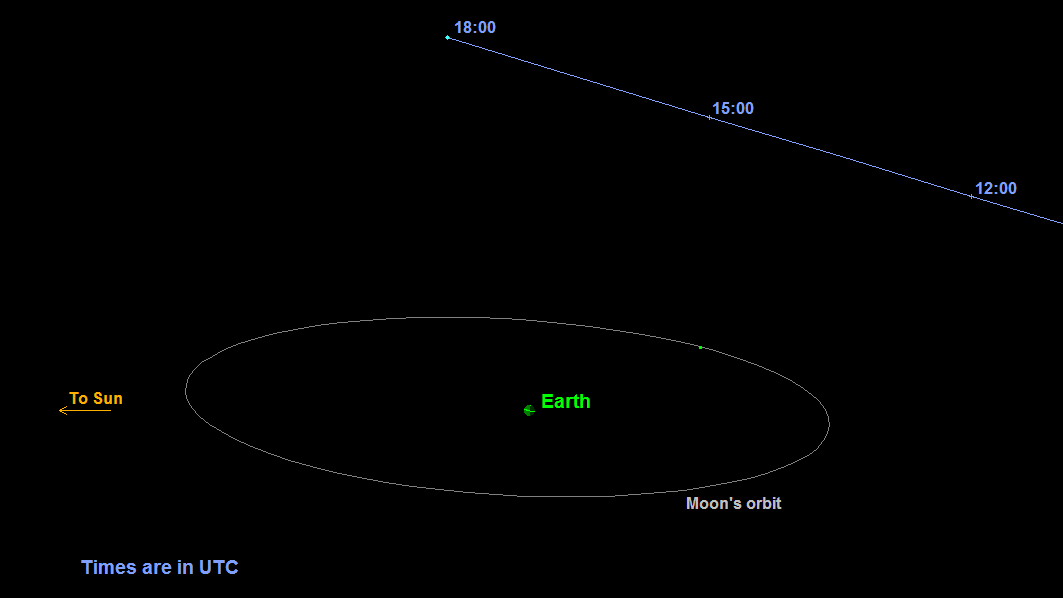
This is a graphic depicting the orbit of asteroid 2015 TB145. The asteroid will safely fly past Earth slightly farther out than the moon’s orbit on Oct. 31 at 10:05 a.m. Pacific (1:05 p.m. EDT and 17:05 UTC). Image credit: NASA/JPL-Caltech

NASA scientists are tracking the upcoming Halloween flyby of asteroid 2015 TB145 with several optical observatories and the radar capabilities of the agency’s Deep Space Network at Goldstone, California. The asteroid will fly past Earth at a safe distance slightly farther than the moon’s orbit on Oct. 31 at 1:05 PM EDT. Scientists are treating the flyby of the estimated 1,300-foot-wide asteroid as a science target of opportunity, allowing instruments on “spacecraft Earth” to scan it during the close pass.

Asteroid 2015 TB145 was discovered on Oct. 10, 2015, by the University of Hawaii’s Pan-STARRS-1 (Panoramic Survey Telescope and Rapid Response System) on Haleakala, Maui, part of the NASA-funded Near-Earth Object Observation (NEOO) Program. According to the catalog of near-Earth objects (NEOs) kept by the Minor Planet Center, this is the closest currently known approach by an object this large until asteroid 1999 AN10, at about 2,600 feet in size, approaches at about 238,000 miles from Earth in August 2027.

“The trajectory of 2015 TB145 is well understood,” said Paul Chodas, manager of the Center for Near Earth Object Studies at NASA’s Jet Propulsion Laboratory, Pasadena, California. “At the point of closest approach, it will be no closer than about 300,000 miles — 480,000 kilometers or 1.3 lunar distances. Even though that is relatively close by celestial standards, it is expected to be fairly faint, so night-sky Earth observers would need at least a small telescope to view it.”

The gravitational influence of the asteroid is so small it will have no detectable effect on the moon or anything here on Earth, including our planet’s tides or tectonic plates.

The Center for NEO Studies at JPL is a central node for NEO data analysis in NASA’s Near-Earth Object Observation Program and a key group involved with the international collaboration of astronomers and scientists who keep watch on the sky with their telescopes, looking for asteroids that could be a hazard to impact our planet and predicting their paths through space for the foreseeable future.

“The close approach of 2015 TB145 at about 1.3 times the distance of the moon’s orbit, coupled with its size, suggests it will be one of the best asteroids for radar imaging we’ll see for several years,” said Lance Benner, of JPL, who leads NASA’s asteroid radar research program. “We plan to test a new capability to obtain radar images with two-meter resolution for the first time and hope to see unprecedented levels of detail.”

During tracking, scientists will use the 110-foot DSS 13 antenna at Goldstone to bounce radio waves off the asteroid. Radar echoes will in turn be collected by the National Radio Astronomy Observatory’s Green Bank Telescope in Green Bank, West Virginia, and the National Astronomy and Ionosphere Center’s Arecibo Observatory, Puerto Rico. NASA scientists hope to obtain radar images of the asteroid as fine as about seven feet per pixel. This should reveal a wealth of detail about the object’s surface features, shape, dimensions and other physical properties.

“The asteroid’s orbit is very oblong with a high inclination to below the plane of the solar system,” said Benner. “Such a unique orbit, along with its high encounter velocity — about 22 miles per second — raises the question of whether it may be some type of comet. If so, then this would be the first time that the Goldstone radar has imaged a comet from such a close distance.”

NASA’s Near-Earth Object Observations Program detects, tracks and characterizes asteroids and comets passing within 30 million miles of Earth using both ground- and space-based telescopes. The NEOO Program, sometimes called “Spaceguard,” discovers these objects, characterizes the physical nature of a subset of them, and predicts their paths to determine if any could be potentially hazardous to our planet. There are no known credible impact threats to date — only the ongoing and harmless in-fall of meteoroids, tiny asteroids that burn up in the atmosphere.

Perseid meteor shower a good show

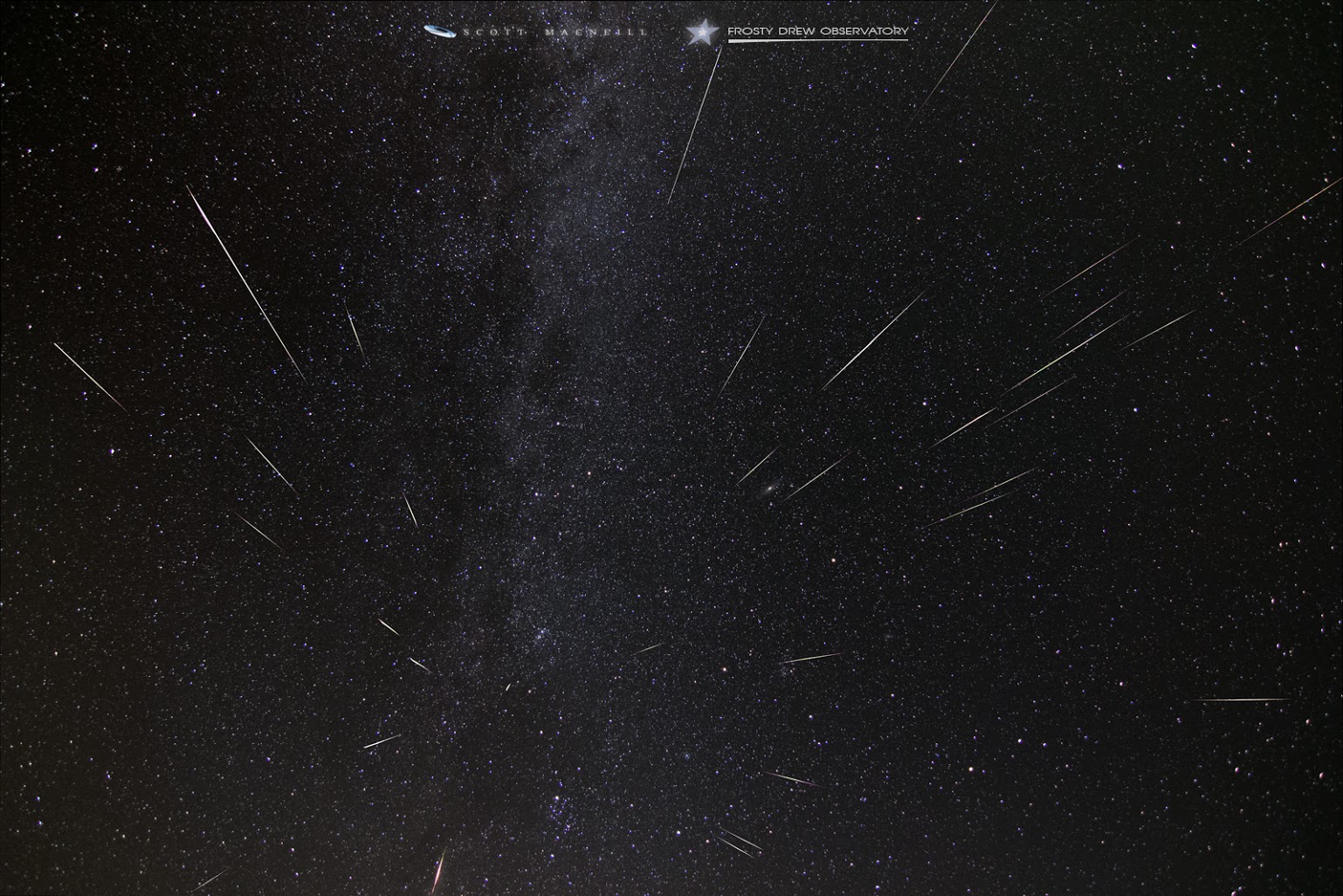
Photo: 2015 Perseids meteor shower imaged over five hours by Scott MacNeill
2015 Perseids Peak by Scott MacNeill, Frosty Drew Observatory, Charlestown, Rhode Island – http://exitpupil.org/

For those with a dark site from which to watch, and the patience to “wait for it…” the 2015 Perseids meteor shower was a good show. Reports from around the world noted substantial numbers of “shooting star” sightings. In the Northeastern Ohio area, amateurs reported from 25 to as many as 57 meteors per hour from good viewing locations. Local observers reported seeing persistent trains, greenish colors, and even flares from some meteors.

The NASA All-Sky “Fireball Network” recorded hundreds of meteors during the event peak, the night of August 12 to 13. “The Perseid shower last night was an almost perfect combinations of circumstances – no Moon, decent shower rates, and clear skies over much of the network,” wrote Dr. Bill Cooke, Meteoroid Environments Office, NASA Marshall Space Flight Center.

Photo: Long Trail of a Perseid Fireball Recorded at 9:42 PM, August 12 via NASA All-Sky Fireball Network
Long Trail of a Perseid Fireball Recorded at 9:42 PM EDT, August 12

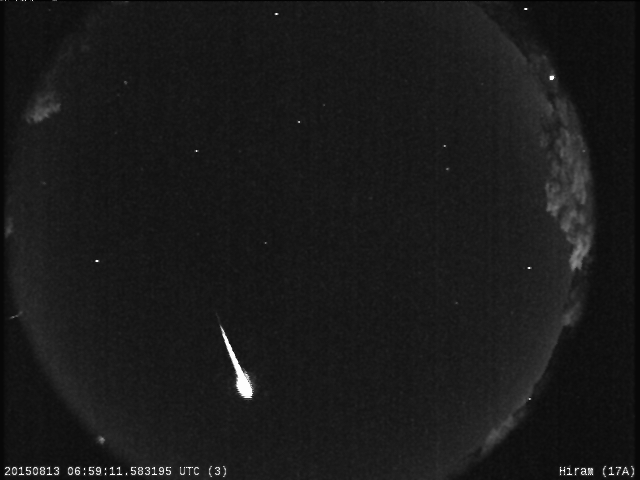
The Fireball Network camera system located on the campus of Hiram College recorded a good number of fireballs — meteors brighter than the planet Venus — overnight including several that appeared directly overhead and at least one that appears to have ended in a flare … a bolide. In the images we have posted here, the top of the photo is north and the bottom is south.

Photo: Apparent Perseid Bolide over Hiram at 2:59 AM EDT. NASA All-Sky Fireball Network
Apparent Perseid Bolide over Hiram at 2:59 AM EDT, August 13

The Perseid meteors are associated with the stream of dusty debris called the Perseid cloud and stretches along the orbit of the comet Swift–Tuttle. Meteors appear when Earth passes through the dust cloud and bits of cometary material plunge into the atmosphere where friction heats and vaporizes them. The debris particles enter Earth’s atmosphere at around 35 miles per second and most are about the size of grains of sand. The name of the shower is derived from the fact that the meteors, if traced back along their paths, appear to radiate from the constellation Perseus.

Pluto, at last!

Photo: Pluto as imaged by NASA's New Horizons spacecraft on July 13, 2015.
Portrait of a Mysterious World – Credits: NASA/APL/SwRI

Pluto nearly fills the frame in this image from the Long Range Reconnaissance Imager (LORRI) aboard NASA’s New Horizons spacecraft, taken on July 13, 2015 when the spacecraft was 476,000 miles (768,000 kilometers) from the surface. This is the last and most detailed image sent to Earth before the spacecraft’s closest approach to Pluto on July 14. The color image has been combined with lower-resolution color information from the Ralph instrument that was acquired earlier on July 13. This view is dominated by the large, bright feature informally named the “heart,” which measures approximately 1,000 miles (1,600 kilometers) across. The heart borders darker equatorial terrains, and the mottled terrain to its east (right) are complex. However, even at this resolution, much of the heart’s interior appears remarkably featureless — possibly a sign of ongoing geologic processes.

After a decade-long journey through our solar system, New Horizons made its closest approach to Pluto Tuesday, about 7,750 miles above the surface making it the first-ever space mission to explore a world so far from Earth. The three-billion-mile journey took about one minute less than predicted when the craft was launched in January 2006. The spacecraft threaded the needle through a 36-by-57 mile (60 by 90 kilometers) window in space — the equivalent of a commercial airliner arriving no more off target than the width of a tennis ball.

Photo: Clyde Tombaugh
Clyde Tombaugh

The Pluto story began only a generation ago when young Clyde Tombaugh was tasked to look for Planet X, theorized to exist beyond the orbit of Neptune. He discovered a faint point of light that we now see as a complex and fascinating world. As a tribute to Tombaugh, who died in 1997 at age 90, a tiny canister of his ashes was placed inside the New Horizons spacecraft.

“Pluto was discovered just 85 years ago by a farmer’s son from Kansas, inspired by a visionary from Boston, using a telescope in Flagstaff, Arizona,” said John Grunsfeld, associate administrator for NASA’s Science Mission Directorate in Washington. “Today, science takes a great leap observing the Pluto system up close and flying into a new frontier that will help us better understand the origins of the solar system.”

New Horizons’ flyby of the dwarf planet and its five known moons is providing an up-close introduction to the solar system’s Kuiper Belt, an outer region populated by icy objects ranging in size from boulders to dwarf planets. Kuiper Belt objects, such as Pluto, preserve evidence about the early formation of the solar system.

Spacecraft returns images hinting of surface features on Pluto, possible polar cap

For the first time, images from NASA’s New Horizons spacecraft are revealing bright and dark regions on the surface of faraway Pluto – the primary target of the New Horizons close flyby in mid-July.

Photo: Motion GIF of Charon and Pluto. Credits: NASA/JHU-APL/SwRI
Click for Full-Size View – Credits: NASA/JHU-APL/SwRI

The images were captured in early to mid-April from within 70 million miles (113 million kilometers), using the telescopic Long-Range Reconnaissance Imager (LORRI) camera on New Horizons. A technique called image deconvolution sharpens the raw, unprocessed images beamed back to Earth. New Horizons scientists interpreted the data to reveal the dwarf planet has broad surface markings – some bright, some dark – including a bright area at one pole that may be a polar cap.

“As we approach the Pluto system we are starting to see intriguing features such as a bright region near Pluto’s visible pole, starting the great scientific adventure to understand this enigmatic celestial object,” says John Grunsfeld, associate administrator for NASA’s Science Mission Directorate in Washington. “As we get closer, the excitement is building in our quest to unravel the mysteries of Pluto using data from New Horizons.”

Also captured in the images is Pluto’s largest moon, Charon, rotating in its 6.4-day long orbit. The exposure times used to create this image set – a tenth of a second – were too short for the camera to detect Pluto’s four much smaller and fainter moons.

Since it was discovered in 1930, Pluto has remained an enigma. It orbits our sun more than 3 billion miles (about 5 billion kilometers) from Earth, and researchers have struggled to discern any details about its surface. These latest New Horizons images allow the mission science team to detect clear differences in brightness across Pluto’s surface as it rotates.

“After traveling more than nine years through space, it’s stunning to see Pluto, literally a dot of light as seen from Earth, becoming a real place right before our eyes,” said Alan Stern, New Horizons principal investigator at Southwest Research Institute in Boulder, Colorado. “These incredible images are the first in which we can begin to see detail on Pluto, and they are already showing us that Pluto has a complex surface.”

The images the spacecraft returns will dramatically improve as New Horizons speeds closer to its July rendezvous with Pluto.

“We can only imagine what surprises will be revealed when New Horizons passes approximately 7,800 miles (12,500 kilometers) above Pluto’s surface this summer,” said Hal Weaver, the mission’s project scientist at the Johns Hopkins University Applied Physics Laboratory (APL) in Laurel, Maryland.

From a NASA news release.